TL;DR
- Since 15 July 2026, GitHub Actions tokens for new repositories carry the owner ID and the repository ID in the sub claim. Older repositories keep the name-only format until you opt in, so a credential has to match the format the repository really emits.
- Entra wildcard credentials are still in preview. Microsoft's docs say a GitHub expression must also match repository_id or repository_owner_id. In my lab Entra accepted a sub-only expression, and an owner-wide one issued a token to another repository of the same owner. I still add repository_id.
- WorkOS shipped agent identity (Agent Auth, early access, 2 Sep), Claude auto-connect for MCP Auth (early access, 3 Nov) and RFC 8693 token exchange for Connect (10 Nov). I found no WorkOS item about federating workloads from another issuer.
- What I would do: trust the immutable sub, add repository_id to every wildcard, delete credentials for repositories that no longer exist, and prove it with real runs. My lab does that for GitHub Actions to Azure.
I read the primary pages for these items on 20 November 2026: GitHub’s changelog and docs, Microsoft Learn and the WorkOS changelog. Dates below are the ones those pages show. The first two items matter for my GitHub Actions to Azure lab, which is why I am putting them together.
GitHub puts owner and repo IDs in the sub claim#
On 23 April 2026 GitHub announced immutable subject claims for Actions OIDC tokens. The post was edited on 10 June 2026: the delimiter between a name and its ID is now @, not -. If you copied an example from the April text, check it.
The rules, from the OIDC reference:
- Repositories created after 15 July 2026 get the new default
sub. Renames and transfers after that date also move to it. - Older repositories keep the name-only format until you opt in. You can do that per organization or per repository, in the OIDC settings or with the REST API (
use_immutable_subject). - GitHub Enterprise Server is not included.
- A custom claim template cannot drop the IDs. With
include_claim_keys,owner_idandrepo_idstay in thereposegment.
| Format | sub for a push to main |
|---|---|
| Name only | repo:octo-org/octo-repo:ref:refs/heads/main |
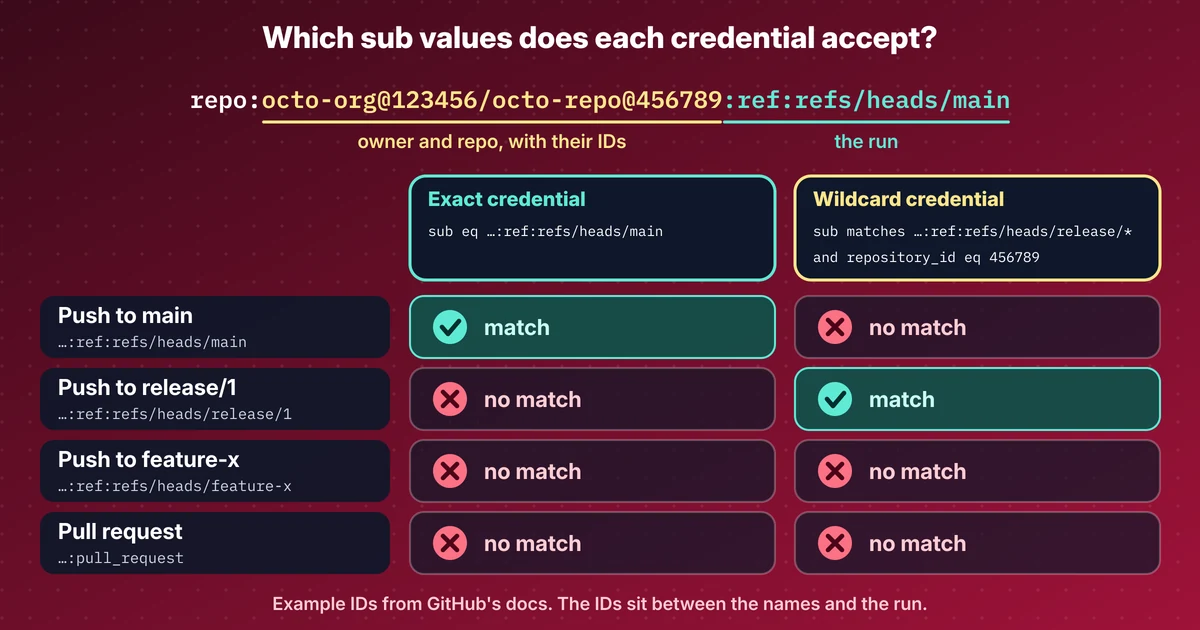
| Immutable | repo:octo-org@123456/octo-repo@456789:ref:refs/heads/main |
The example values come from GitHub’s docs. The reason is in the changelog: if a repository or organization name is recycled, a new owner can mint tokens with the same subject and reach cloud resources that still trust the original one. The IDs are never reused, so the old trust does not transfer.
In my lab I created a fresh private repository and its sub came out in the new format. That changes the setup order. I create the repository first, read the two IDs from the API, and only then create the federated credential. GitHub’s docs show the immutable format for Azure, AWS, Google Cloud and HashiCorp Vault trust policies. I only tested Azure.
What Entra can match now#
Microsoft still labels flexible federated identity credentials as preview. The page is dated 18 September 2026. Instead of one exact subject, the credential carries a claimsMatchingExpression with languageVersion set to 1, and subject must be null. The concept page says the Azure CLI has no explicit support yet and shows az rest against Graph beta, which is what I used for an app registration. The CLI reference for az identity federated-credential (user-assigned managed identities) does list --claims-matching-expression-* parameters, marked Preview.
| Operator | What it does |
|---|---|
eq |
Exact match on one claim |
matches |
Wildcards: * for any run of characters, ? for one character |
and |
Combines conditions on several claims |
For GitHub, Microsoft’s setup page says the expression must match sub and one or both of repository_id and repository_owner_id. That holds whether sub is name-based, customized or immutable. sub and job_workflow_ref accept eq and matches. The two ID claims accept only eq. Microsoft’s migration guide uses this example:
claims['sub'] matches 'repo:octo-org@123456/octo-repo@456789:*' and claims['repository_id'] eq '456789'Microsoft also published a migration guide, dated 28 July 2026. The order is: create a credential for the immutable subject next to the old one, enable immutable subjects in GitHub, validate a run, then delete the old credential. A companion page on mutable subjects describes subject recycling and asks you to delete dangling credentials, the ones whose workload no longer exists.
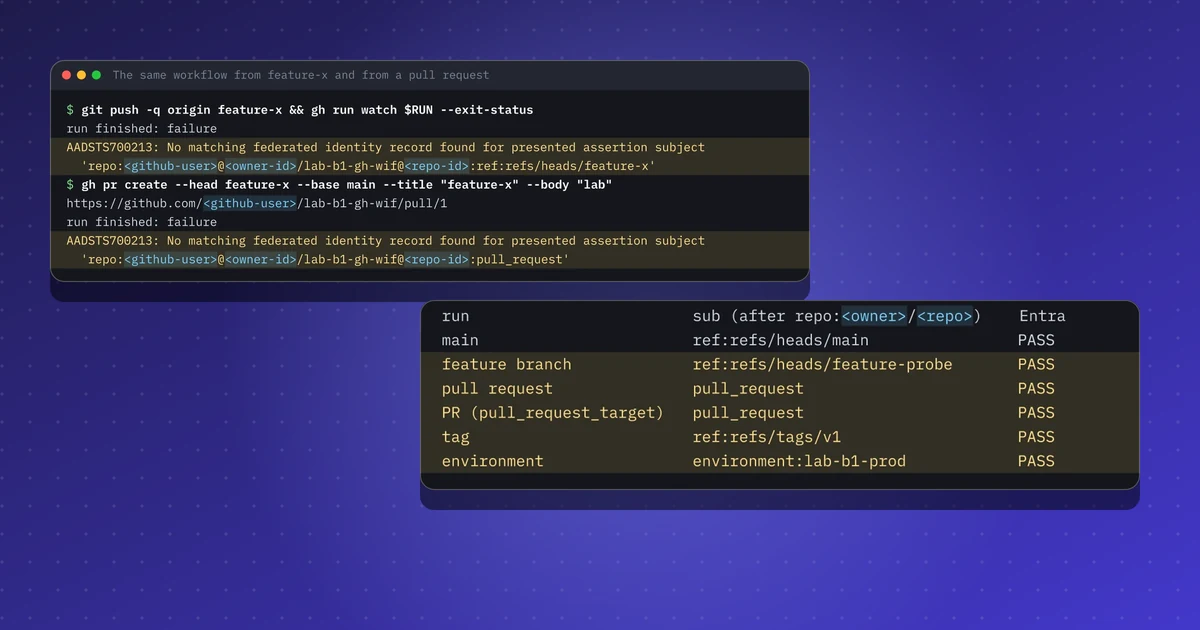
Here my own run differs from the docs. In the lab I created two expressions that matched only sub (feature-* and v*), with no repository_id. Entra accepted both and the matching runs passed. Those patterns contained the owner and repository IDs, so they were pinned anyway. In a later check the same day, Entra also accepted an owner-wide expression with no repository_id or repository_owner_id clause, and that credential issued a token to a different repository of the same owner. I still recommend adding repository_id. Microsoft documents it as required and the feature is in preview, so a sub-only credential may be refused or stop matching later. And the ID check does not depend on writing the pattern right: an owner-wide wildcard already issued a token to another of my repositories, and a name-only sub of an older repository can match a name you no longer own.
How one token meets two credentials#
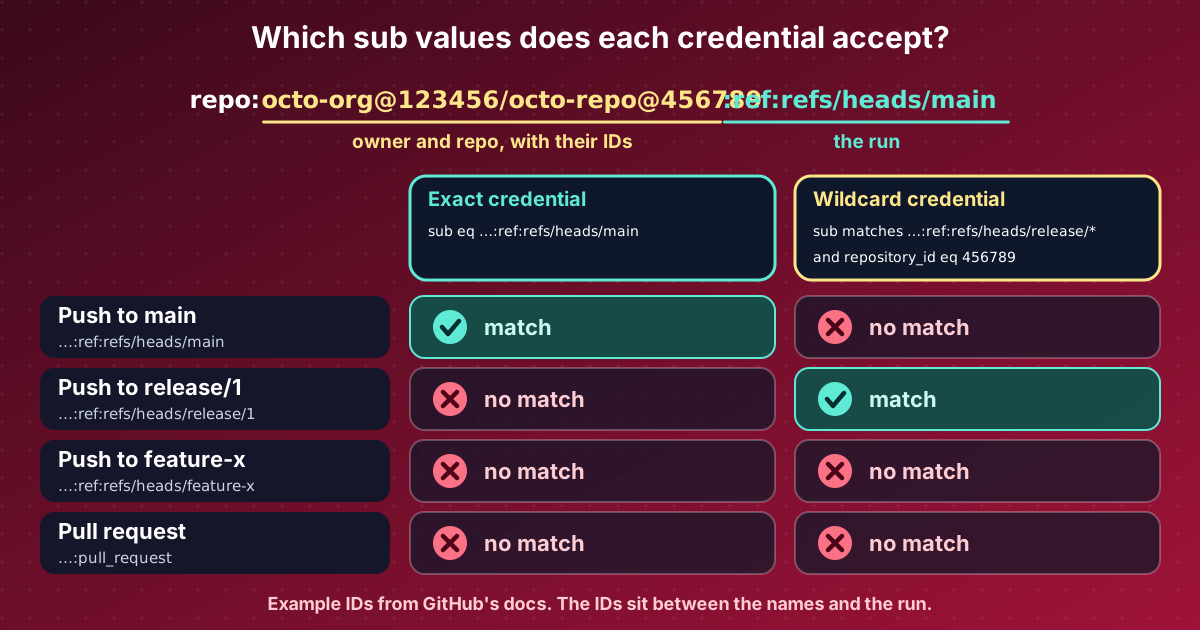
The point of the picture: the part of sub after the IDs is the run. A push to main, a push to a release branch, a feature branch and a pull request each send a different value, and Entra compares it with the credential. The IDs in the middle are what stop another repository with the same name from matching. My lab runs each of these and prints the exact sub for every case.
WorkOS: what I found#
I checked the WorkOS changelog because it keeps shipping auth for agents and MCP. These are the items from August to 20 November that touch agent or workload credentials:
| Date | Item | What WorkOS says |
|---|---|---|
| 2 Sep 2026 | Agent Auth | Early access. Agents get identities in AuthKit and short-lived, tightly scoped tokens on every run, delegated for a user or autonomous within an organization. Sessions can be revoked instantly. |
| 4 Sep 2026 | MCP Enterprise-Managed Authorization (EMA) | MCP Auth supports EMA, so an MCP client can reach downstream MCP servers through the company’s identity provider without a consent screen per app. Access on request. |
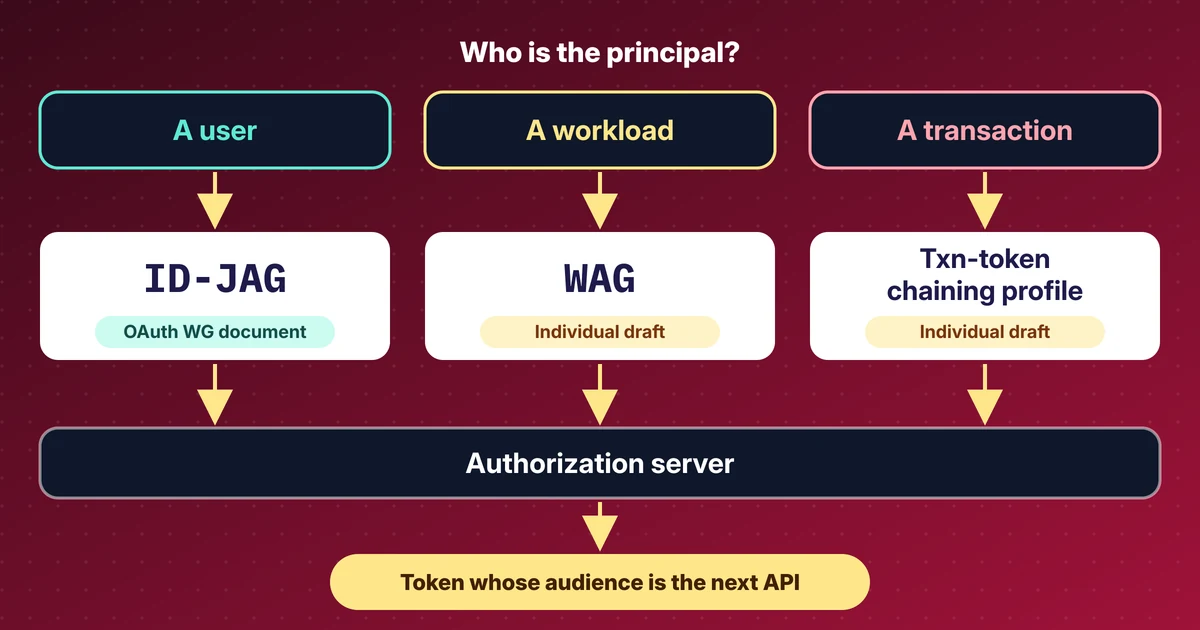
| 3 Nov 2026 | Claude auto-connect | Early access. For organizations whose identity provider does not support Cross App Access, Claude issues the identity assertion (ID-JAG) and MCP Auth exchanges it for an access token to your MCP server. |
| 10 Nov 2026 | Token exchange for WorkOS Connect | RFC 8693. A first-party Connect app can exchange a token for another registered resource, carry key claims forward and narrow the scopes. |
The last two connect to things I already wrote. Claude auto-connect is the ID-JAG flow from ID-JAG explained, with Claude as the issuer. The token exchange is the pattern my MCP no-passthrough lab builds by hand.
None of this is workload identity federation in the Entra sense, where you trust tokens from another issuer. I found no WorkOS changelog item about that, and none about machine-to-machine auth. What the items share with the GitHub story is the idea of a short-lived, narrow credential for each run instead of a stored key. Two other agent items, Agent Registration (4 August) and Agent Vault (17 November), are about letting agents sign in to AuthKit with the auth.md protocol and giving them signed-in browser sessions, so I left them out. I did not try any WorkOS product.
What I would do#
This is my opinion, not Microsoft’s or GitHub’s guidance.
- For a new repository, check any credential you wrote from older examples. The subject now has IDs in it, and a name-only subject will not match.
- For an old repository, follow Microsoft’s order: add the immutable credential, opt in, run a workflow, then delete the old credential.
- Put
repository_idin every expression, even when the pattern contains the IDs. Entra accepted sub-only expressions in my lab, and an owner-wide one issued a token to another repository of the same owner. The docs still require the ID check, and I still add it. - List the federated credentials on your app registrations and delete the ones whose repository is gone.
The lab shows the failure that follows from exact matching. With only a credential for main, one of six kinds of run passed. It also shows a trap: a credential for pull_request also trusts pull_request_target runs, and those get secrets.
What I did not check#
- I did not opt an existing repository in, and I did not call GitHub’s preview endpoint that shows the new subject prefix.
- I tested only Azure. AWS, Google Cloud and Vault are in GitHub’s docs, and I did not run them.
- I did not test GitHub Enterprise Server, which GitHub excludes.
- I read the WorkOS changelog entries and did not try any product or read the linked docs. Two of the items are early access.
- Microsoft’s flexible credential pages still say preview. I did not find a general availability date, and I am not guessing one.
Sources#
- GitHub Changelog, 23 Apr 2026 (edited 10 Jun 2026): Immutable subject claims for GitHub Actions OIDC tokens
- GitHub Docs: OpenID Connect reference (immutable subject claims)
- GitHub Docs: REST API endpoints for GitHub Actions OIDC
- Microsoft Learn: Flexible federated identity credentials (preview)
- Microsoft Learn: Set up a flexible federated identity credential (preview)
- Microsoft Learn: Migrate GitHub Actions federated credentials to immutable subjects
- Microsoft Learn: Mutable subjects in federated identity credentials
- Microsoft Learn: az identity federated-credential (Azure CLI)
- WorkOS changelog, 2 Sep 2026: Agent Auth
- WorkOS changelog, 4 Sep 2026: MCP Enterprise-Managed Authorization (EMA)
- WorkOS changelog, 3 Nov 2026: WorkOS MCP Auth supports Claude auto-connect
- WorkOS changelog, 10 Nov 2026: Token exchange for WorkOS Connect
Discuss this post#
Found it useful? Share it, and tell me what you think.
This post as Markdown · RSS · JSON feed
New posts by email
One email a week with new posts and labs. Unsubscribe anytime.
Your address is stored with Kit, which sends the emails. Details