TL;DR
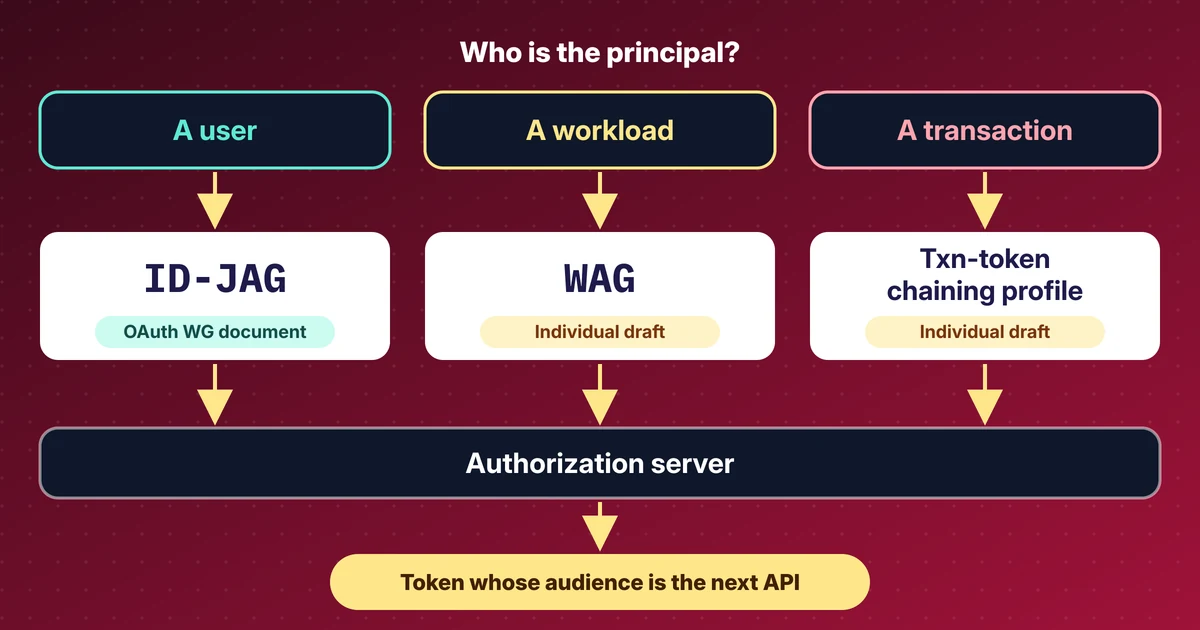
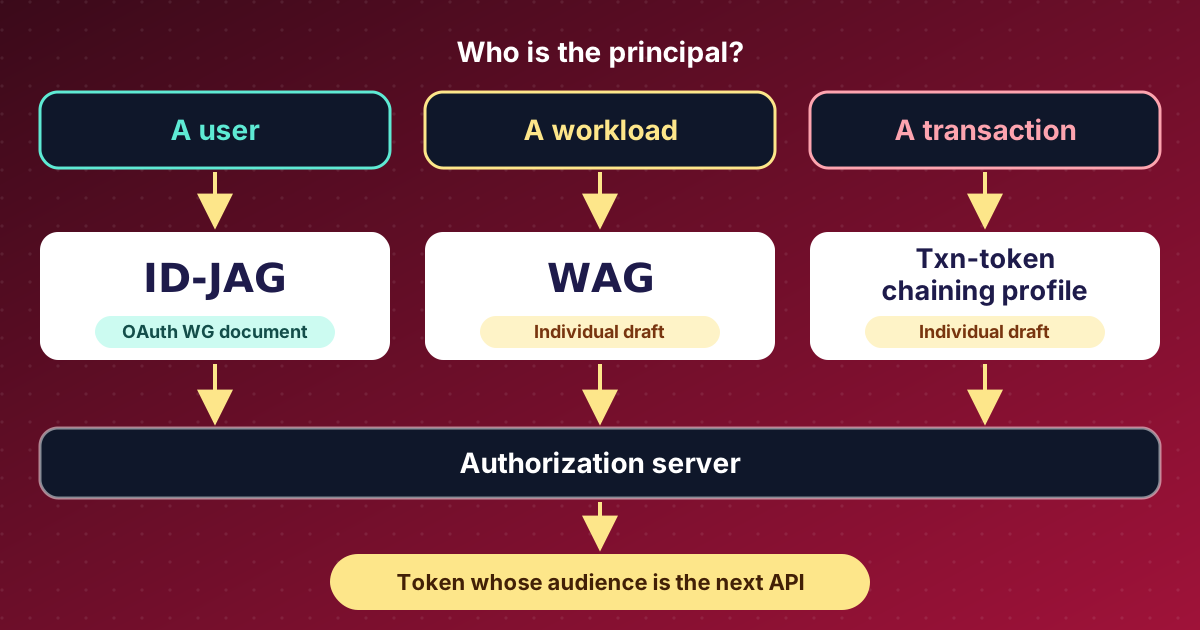
- IETF 127 treated agent delegation as three cases: a user (ID-JAG), a workload acting for itself (Workload Authorization Grant, WAG) and a transaction in progress (a transaction-token grant).
- ID-JAG is at draft -06 and still an OAuth working group document. Just-in-time provisioning and key binding are moving to separate drafts, and gateways in the middle are the open problem.
- WAG, the transaction-token profile, Transactional Access Tokens, the Actor Profile and the three newest delegation drafts are individual drafts. Nothing in them is adopted or final.
- For your own designs: classify each agent flow by who the principal is, never forward the inbound token to the next hop, and write the draft revision into any design that depends on one.
IETF 127 met in San Francisco this week. I did not attend. I read the slides, the volunteer meeting notes and the current drafts for the OAuth and WIMSE sessions, and I checked every draft name and revision on datatracker.ietf.org on 20 November 2026.
The OAuth session was on Wednesday 18 November. WIMSE met that evening (22:00 UTC), and the joint OAuth and WIMSE session followed on Thursday 19 November. OAuth has one more session today, which has not happened as I write this. I quote the notes as notes. They are not decisions.
Three grants for three kinds of principal#
In the joint session, Justin Richer proposed a simple taxonomy, recorded in the WIMSE notes: ID-JAG is about a person, WAG is about a workload, and “TAG” is about a transaction in progress. “TAG” is a nickname from the discussion. It is not a draft or a registered name.
| Case | Draft I checked | Where it stands |
|---|---|---|
| A user | draft-ietf-oauth-identity-assertion-authz-grant-06 (ID-JAG) | OAuth working group document, posted 31 Oct 2026 |
| A workload acting for itself | draft-carleton-workload-authz-grant-02 (WAG) | Individual draft, “Informational”, posted 2 Nov 2026 |
| A transaction in progress | draft-fletcher-oauth-txn-token-chaining-profile-01 | Individual draft, posted 26 Oct 2026 |
ID-JAG and the transaction-token profile are both profiles of identity chaining. That draft is at -17 and the datatracker shows it in the RFC Editor queue, with the status “blocked: Final Approval Pending”. The WIMSE notes call it “RFC 10092 (to be)”. The datatracker shows no RFC number yet, so I would not quote one.
ID-JAG at draft -06#
The ID-JAG slides list what changed in -05 and -06. These are the ones I would read first:
- A key-bound ID-JAG can replace client authentication at the resource authorization server.
- Token exchange is limited to a single audience. An unknown audience gets
invalid_target. - mTLS binding was added, and a DPoP-bound ID-JAG requires the
jwt-dpopgrant type. - A new Subject Identifier Mapping section, tenant checks, and an
id_jag_signing_alg_values_supportedmetadata value. - A Privacy Considerations section.
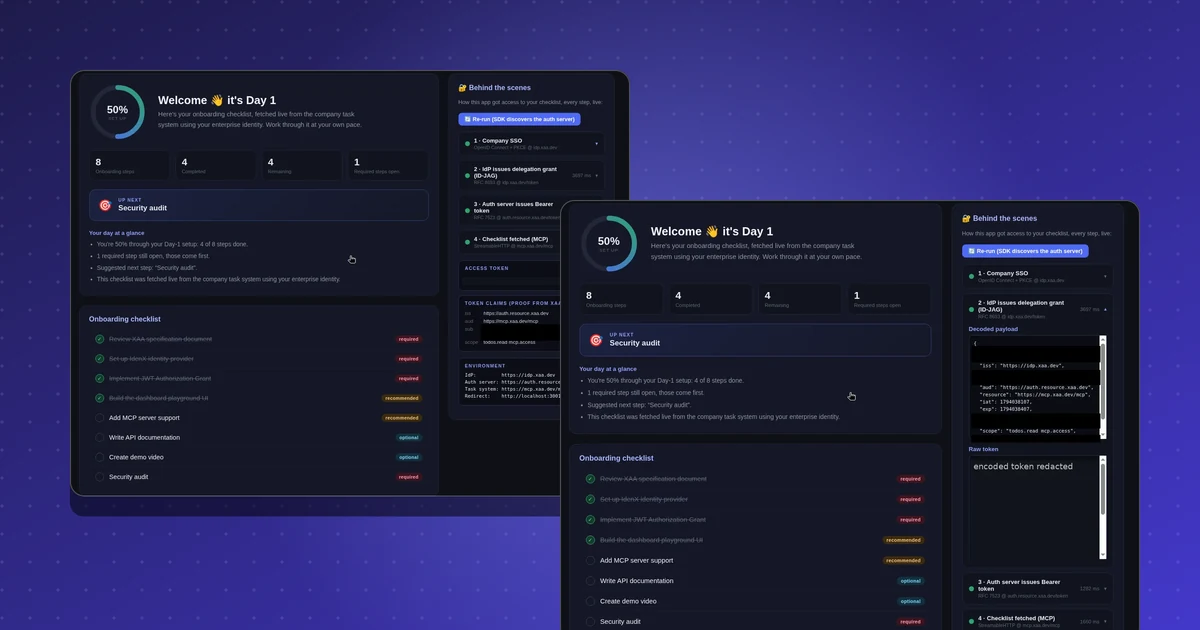
The slides also list who implements it. The list includes Okta, Ping, Auth0, Descope, Keycloak, WorkOS and Oracle OCI IAM. If you want the basics first, I wrote them up in ID-JAG explained.
Three themes came out of implementation experience, and each one went somewhere other than the core draft:
- Just-in-time provisioning (issues #83 and #121). The recommendation is a future extension. An app may now meet a user for the first time through an ID-JAG, and custom claims are allowed but not necessarily interoperable.
- Key binding (issue #103). The slides list the missing pieces as draft-mcguinness-oauth-token-exchange-cnf and draft-parecki-oauth-jwt-dpop-grant, and ask whether to pull key binding into its own extension. In the notes, Hannes said that punting to other documents leaves the draft looking undone. Aaron Parecki answered that provisioning is optional and that binding applies more widely than ID-JAG.
- Gateways and proxies (issue #114). A gateway in the middle performs the token exchange, but the ID token’s audience is the client that called the gateway, so the audience check fails. The slides suggest declaring intermediaries out of scope and point to draft-mcguinness-oauth-id-continuation-assertion as an extension.
The authors asked for interim meetings on gateways and on key binding. The next steps on the slides are to triage the remaining issues into -07 or an explicit deferral, and then to ask for working group last call.
My opinion: the core grant looks stable enough to build against. I would not build a gateway-in-the-middle design on it yet, because that is the one case the authors themselves moved out.
WAG: the workload version#
The WAG draft describes a platform whose workload identity provider signs an RFC 7523 JWT grant that names one workload. A third party’s authorization server is configured once to trust that provider and does not reject a workload because it has not seen it before. The draft says an AI agent is the motivating case, and that access on behalf of a user is out of scope.
It also says plainly that it is an early, exploratory individual draft and not a working group document. At the WIMSE session, Aaron Parecki said ID-JAG is fundamentally about a user, and without a user the case looks like WAG. Jeff Lombardo said he was very supportive of adoption. Karl McGuinness argued for keeping the principal types separate instead of making the receiver infer them from claims. The notes record no objection to the idea. They do not record an adoption call either.
Client identity came up too. Justin Richer’s talk The Future of Client ID listed the options as dynamic registration, a metadata URL (CIMD), a client ID as a JWT, and a SPIFFE ID. The SPIFFE client authentication draft is at -03 (2 November) and covers the token endpoint only.
Two other WIMSE items matter if you build on these:
- Workload Proof Token (draft-ietf-wimse-wpt-02) moved the proof into the
Authorizationheader. A request has one such header, so a WPT cannot travel with an OAuth access token. Flemming Andreasen called the change inconsistent with the architecture, and Jonathan Rosenberg pointed out that an agent acting for a user needs both an access token and agent authentication. The chair sent the question to the list. - WIMSE Architecture (-09) appeared on 17 November (UTC). The authors think it is ready, and the chairs plan a working group last call in the next few weeks.
In the same session Brian Campbell presented the AI Identity Management System draft, with the line “OAuth in the front, WIMSE in the back”. The notes say it defines no new protocol behavior.
Transaction tokens across a boundary#
Transaction Tokens stay inside one trust domain. George Fletcher’s profile describes how a workload swaps its Txn-Token at its own authorization server for a Txn-Token-JAG (typ of txn-chain+jwt) and presents that to a partner’s server. Per the slides, the grant lives at most 300 seconds, with 60 preferred, the jti is single-use, and the internal call chain never crosses the boundary. The open questions are whether sender constraining should move from SHOULD to MUST, and how to map the subject.
The discussion was the interesting part:
- Max Gerber asked why a new JAG type is needed when ID-JAG and WAG exist. Justin Richer and Pieter Kasselman answered that the input artifact is different and the JAG would carry a redacted subset of its claims.
- Mark Atwood said stripping internal identifiers before a token crosses a boundary should be a MUST. Antoine Fressancourt replied that identifiers still have to be reconstructable for audit.
- Arndt Schwenkschuster worried that transaction tokens become “the new bearer AT” that can be stolen and exchanged. George Fletcher said they are orthogonal to client authentication.
- Justin Richer: “Semantically, the transaction token shouldn’t contain authorization to do work, it should shape work being done.”
The notes close with broad agreement that the work fills a real gap. One housekeeping point: the notes link an older name, draft-fletcher-transaction-token-chaining-profile. The datatracker shows that name as replaced by the oauth-txn one linked above, which is also what the slides use.
Transactional Access Tokens (-01, dated 18 November) take a different route. A Txn-AT is a JWT access token that follows RFC 9068 with a transaction identifier and context, for one resource server, requested through Rich Authorization Requests. The lifetime SHOULD NOT exceed 300 seconds. Token exchange, refresh and client credentials can issue it, authorization code cannot. In the session, a participant named George said there is no need to standardize it, and the author said a standard way is desirable. Justin Richer sent the discussion to the list.
Who the actor is#
The OAuth Actor Profile for Delegation (-01, 9 October) profiles the act claim from token exchange, asks for issuer-scoped actor identifiers and classifies actors with sub_profile. Karl McGuinness’s summary in the notes: make delegation explicit, and the client ID stays the client. Two people spoke for adoption. Another participant said it is not a short piece of work, and Justin Richer thought it was reasonable to seek clarification before adoption. The notes record that the chairs asked for a sense of the room but not what the room said.
A new individual draft goes a step further. Token Exchange with Actor-Bound Tokens (-00, 16 November) lets an orchestrator ask for a token bound to the key of the agent that will do the work. The actor proves possession of that key, so the token works only for that agent. It is an individual draft.
Three more drafts from this week#
All three are individual -00 drafts with no working group status.
- Security Events for Revocation of Agent Delegations (19 Nov). A Security Event Token that revokes a delegation and everything delegated from it, with rules for how agents pass it down the chain, including over a Shared Signals stream. Token Status Lists stay the per-token status mechanism.
- OAuth Brokered Authorization (20 Nov). One durable broker is the OAuth client of the upstream resource. Each short-lived instance gets a sender-constrained token (DPoP or mTLS) for the broker through client credentials, with an
authorization_detailstype ofbrokered_access. An instance never holds a refresh token. - OAuth 2.0 Audience-Bound Client Authorization (18 Nov). Only a client that represents the token’s audience may exchange or introspect it. The link can come from local policy, from a
private_key_jwtchecked against the resource’sjwks_uri, or from a newresource_clientsparameter in RFC 9728 metadata. Friday’s agenda lists the same author’s earlier draft,draft-zehavi-oauth-audience-bound-token-exchange-00. I have not checked how the two relate.
What I would do with this#
This is my opinion, not the standard’s.
- Classify every agent flow by its principal first: a user, a workload, or a transaction. The drafts are splitting along exactly that line, so your design will map onto them more easily.
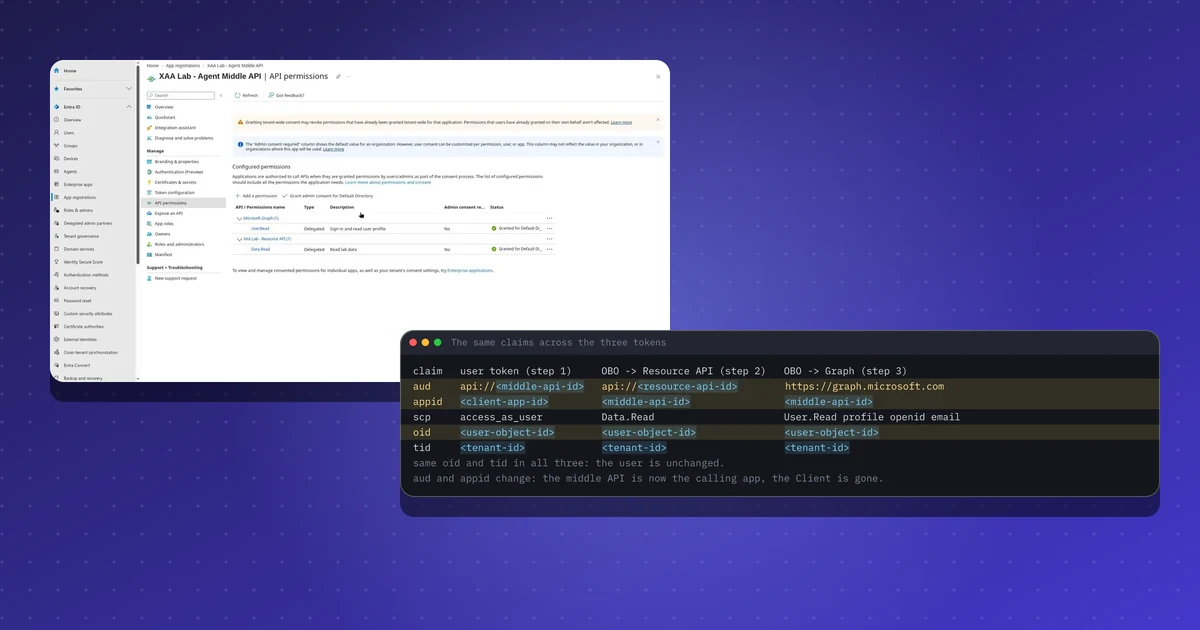
- Do not forward the inbound token to the next hop. Exchange it for one whose audience is the next API. I covered this in MCP server, no token passthrough and Entra on-behalf-of for an agent middle tier.
- Treat the gateway case as unsettled until the interims on issue #114 report back.
- Write the draft name and revision into the design document. Several of these changed name or number within weeks.
What I did not check#
I did not attend any session, and I did not watch the recordings in full. I linked the OAuth session and the WIMSE session 1 recordings. I did not find a recording of the joint session yet, so everything about it comes from the notes. I did not run or implement any of these drafts. The notes were written by volunteers and may contain mistakes. The Friday OAuth session, which includes several of the drafts above, has not taken place yet. I will update this post if something material changes.
Sources#
- IETF 127 OAuth WG agenda (Wednesday, Thursday joint and Friday sessions)
- IETF 127 OAuth WG session notes
- IETF 127 WIMSE session notes (Session 1 and Session 2, joint with OAuth)
- IETF 127 WIMSE session 1 minutes (18 Nov 2026)
- IETF 127 slides: Identity Assertion Authorization Grant (Parecki, McGuinness, Campbell)
- IETF 127 slides: Workload Authorization Grant (WAG)
- IETF 127 slides: Txn-Token Chaining Profile (Fletcher)
- IETF 127 slides: The Future of Client ID (Richer)
- draft-ietf-oauth-identity-assertion-authz-grant-06 (Identity Assertion JWT Authorization Grant)
- draft-ietf-oauth-identity-chaining-17 (OAuth Identity and Authorization Chaining Across Domains)
- draft-carleton-workload-authz-grant-02 (Workload Authorization Grant)
- draft-fletcher-oauth-txn-token-chaining-profile-01 (Transaction Token JWT Authorization Grant Profile)
- draft-tulshi-oauth-transactional-access-tokens-01 (Transactional Access Tokens)
- draft-mcguinness-oauth-actor-profile-01 (OAuth Actor Profile for Delegation)
- draft-nandakumar-oauth-actor-bound-token-exchange-00 (Token Exchange with Actor-Bound Tokens)
- draft-nandakumar-oauth-delegation-revocation-00 (Security Events for Revocation of Agent Delegations)
- draft-sweeney-oauth-brokered-authorization-00 (OAuth Brokered Authorization)
- draft-zehavi-oauth-aud-bound-authz-00 (OAuth 2.0 Audience-Bound Client Authorization)
- draft-ietf-oauth-spiffe-client-auth-03 (OAuth SPIFFE Client Authentication)
- draft-ietf-wimse-arch-09 (WIMSE Architecture)
- draft-ietf-wimse-wpt-02 (WIMSE Workload Proof Token)
- draft-ietf-wimse-aims-01 (AI Identity Management System)
- Recording: IETF 127 Web Authorization Protocol (OAUTH), 2026-11-18 17:00 (IETF, YouTube)
- Recording: IETF 127 Workload Identity in Multi System Environments (WIMSE), 2026-11-18 22:00 (IETF, YouTube)
Discuss this post#
Found it useful? Share it, and tell me what you think.
This post as Markdown · RSS · JSON feed
New posts by email
One email a week with new posts and labs. Unsubscribe anytime.
Your address is stored with Kit, which sends the emails. Details