TL;DR
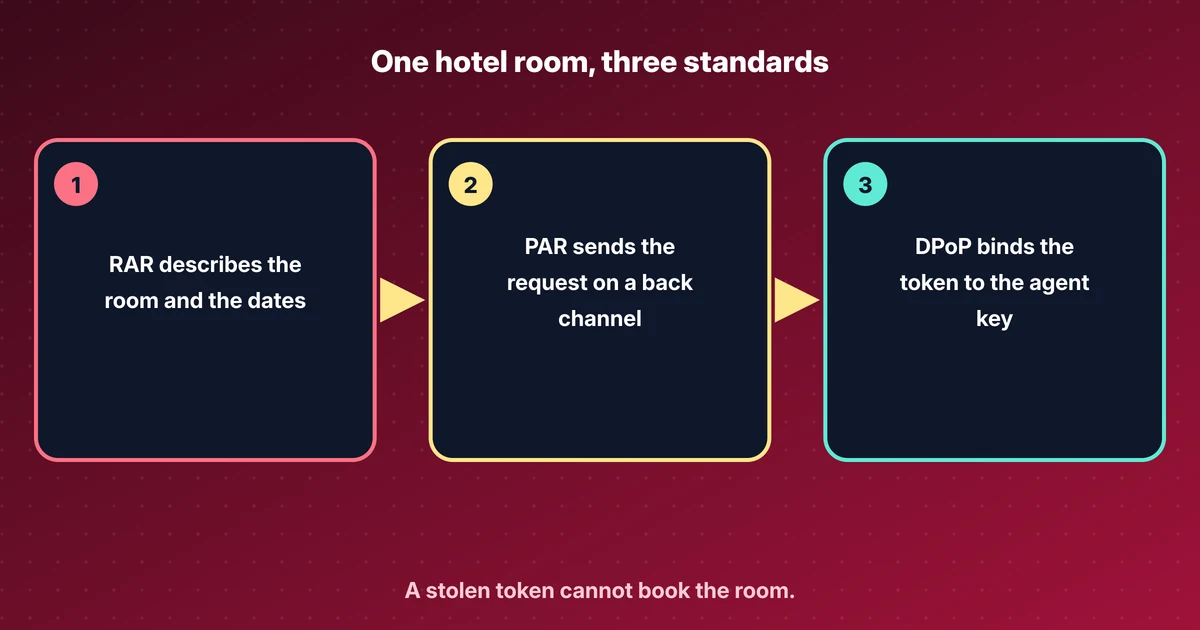
- DPoP (RFC 9449, September 2023) binds an access token to a key the client holds, so a leaked token cannot be used without that key.
- PAR (RFC 9126, September 2021) moves the authorization request to a back channel. The FAPI 2.0 Security Profile requires it.
- RAR (RFC 9396, May 2023) describes the approval itself, for example one hotel room on named dates, instead of a coarse bookings scope.
Your AI agent wants to book one hotel room. Three published OAuth standards decide how that request is described, how it reaches the identity provider, and what a leaked token is worth. One describes the booking. One keeps the request out of the browser address bar. One binds the access token to a key, so a leak does not book the room.
They are Standards Track RFCs, at the Proposed Standard maturity. The FAPI 2.0 Security Profile, approved as an OpenID Final Specification on 19 February 2025, already requires PAR. RFC 9700, published in January 2025, says authorization and resource servers should sender-constrain access tokens, with mTLS or DPoP.
The same ideas showed up again at IETF 127. In the OAuth session on 18 November 2026, a DPoP-bound variant of ID-JAG was on the slides, and transactional access tokens were described as being requested through Rich Authorization Requests. I wrote up that meeting in a separate post.
DPoP binds the token to a key#
DPoP stands for Demonstrating Proof of Possession. RFC 9449 was published in September 2023.
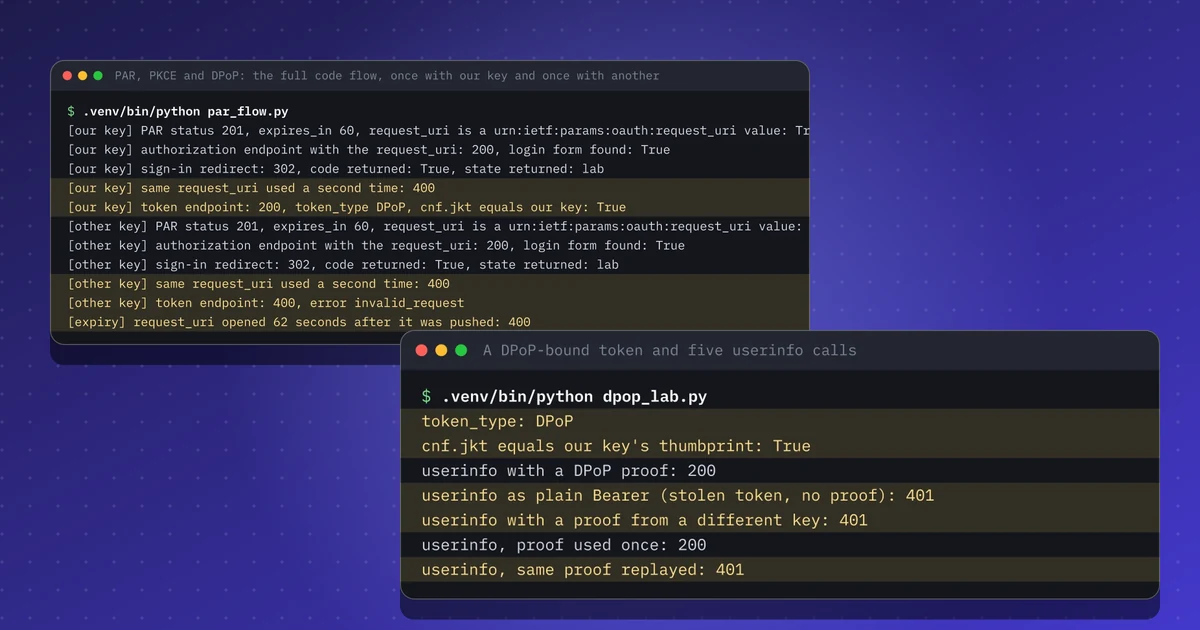
The agent holds a key pair. When it asks for a token, and later when it calls the booking API, it sends a short signed proof that names the HTTP method and the URL. The authorization server binds the access token to that key. The hotel API then accepts the token only with a fresh proof signed by the same key.
A normal access token is a bearer token: anyone who holds it can call the API as the user. A log file or a malware dump is enough. With DPoP, a leaked token is useless without the key, and a replayed proof is refused. That is why a stolen token does not book the room.
PAR keeps the request off the address bar#
PAR, Pushed Authorization Requests, was published in RFC 9126 in September 2021.
The agent first sends the authorization parameters to the identity provider on a back channel, in an authenticated call. The server replies with a short-lived reference, a request_uri. Only then does a redirect carry the client id and that reference, nothing else.
The problem is leakage. A long authorization URL can end up in logs, history and Referer headers. If the request also names the hotel and the dates, that data leaks with it. The FAPI 2.0 Security Profile requires PAR: authorization servers must reject requests that were not pushed, and the reference must expire in less than 600 seconds.
RAR describes the booking itself#
RAR, Rich Authorization Requests, was published in RFC 9396 in May 2023.
Instead of a coarse scope such as bookings, the agent sends a structured description of what is being approved, in authorization_details. For a hotel stay, that can name one room, the hotel, and the dates.
A bookings scope might allow any room, on any date, at any hotel the API will accept. With RAR, the identity provider can show a consent screen that names that one room and those dates, and the API can enforce exactly that booking. Those details can travel in the pushed PAR request, so the hotel and the dates never appear in a URL.
How the three fit together#
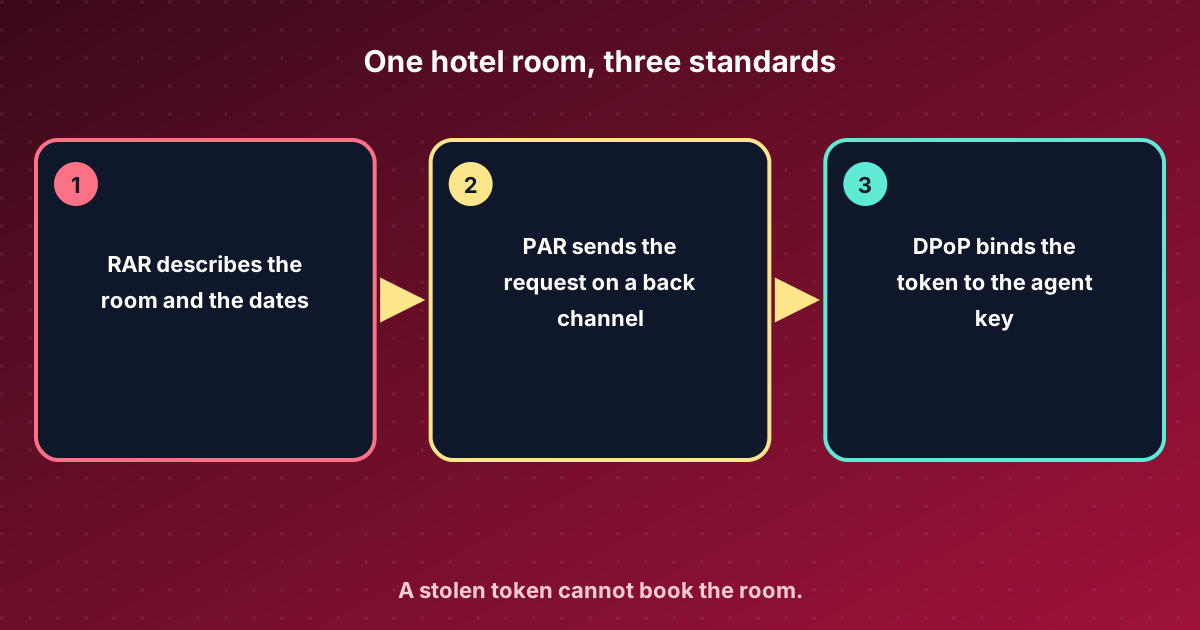
You do not have to switch all three on at once. DPoP helps even when the scope is still a string. PAR helps even for a login that is not a booking. RAR helps even with a bearer token, because the consent is precise. Used together, they match how you would want an agent to book one room.
A hands-on lab runs DPoP and PAR against Keycloak.
Sources#
- RFC 9449: OAuth 2.0 Demonstrating Proof of Possession (DPoP)
- RFC 9126: OAuth 2.0 Pushed Authorization Requests (PAR)
- RFC 9396: OAuth 2.0 Rich Authorization Requests (RAR)
- RFC 9700: Best Current Practice for OAuth 2.0 Security
- OpenID Foundation, 19 Feb 2025: FAPI 2.0 Security Profile and Attacker Model approved as Final Specifications
- FAPI 2.0 Security Profile (Final)
- IETF 127 OAuth working group session notes
This post as Markdown · RSS · JSON feed
New posts by email
One email a week with new posts and labs. Unsubscribe anytime.
Your address is stored with Kit, which sends the emails. Details