TL;DR
- An access token keeps working until it expires, even after the laptop it sits on is reported stolen.
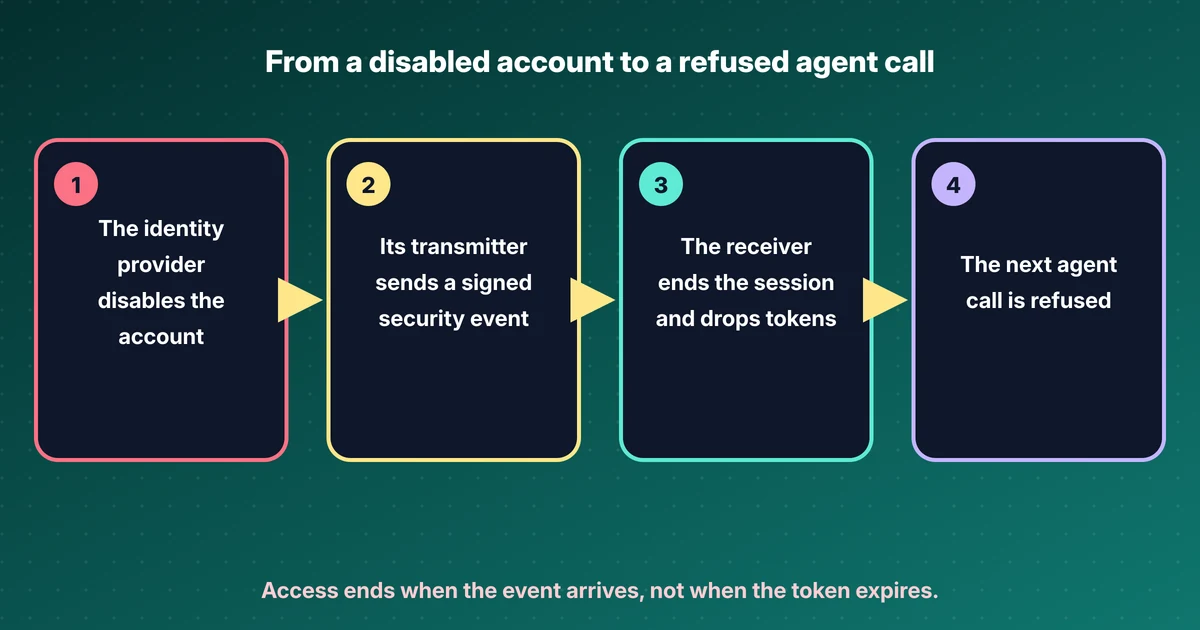
- Shared Signals lets the service that knows, such as device management, push a signed event to every app that subscribed, so the apps end the sessions in seconds.
- Continuous Access Evaluation Profile (CAEP) and Risk Incident Sharing and Coordination (RISC) define the events: session revoked, device compliance changed, credential changed, account disabled. All three specifications became OpenID Final Specifications on 2 September 2025.
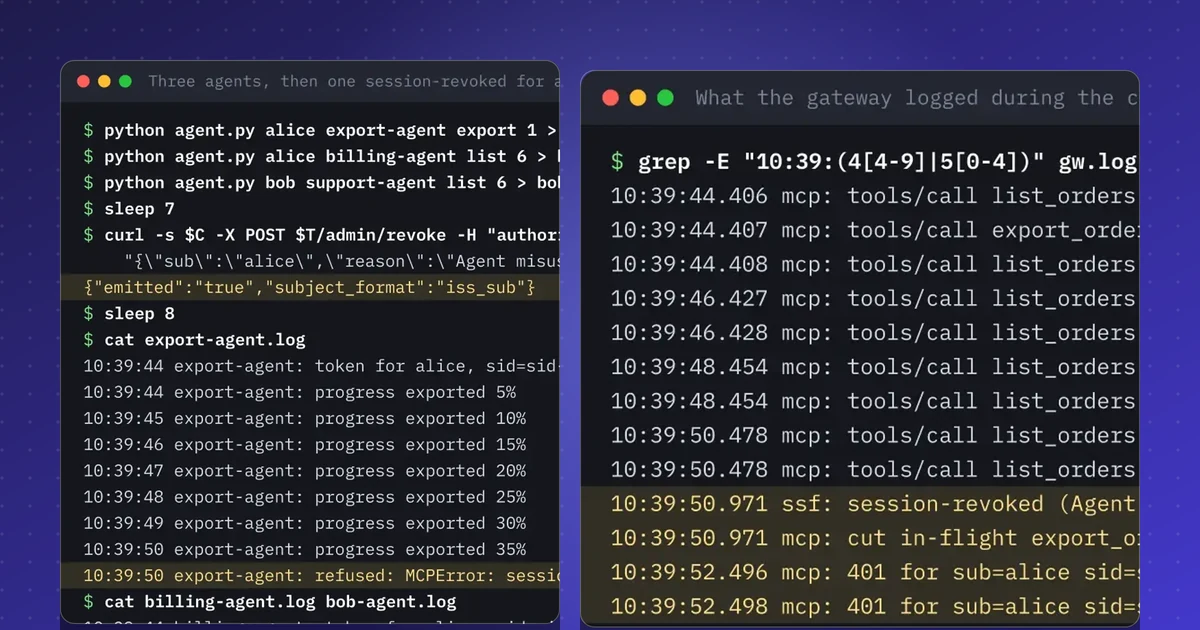
- Each app has to verify, deduplicate and enforce, including work that is already running. My lab cut a running artificial intelligence (AI) agent call in 8 ms, and the Knowledge article goes deeper.
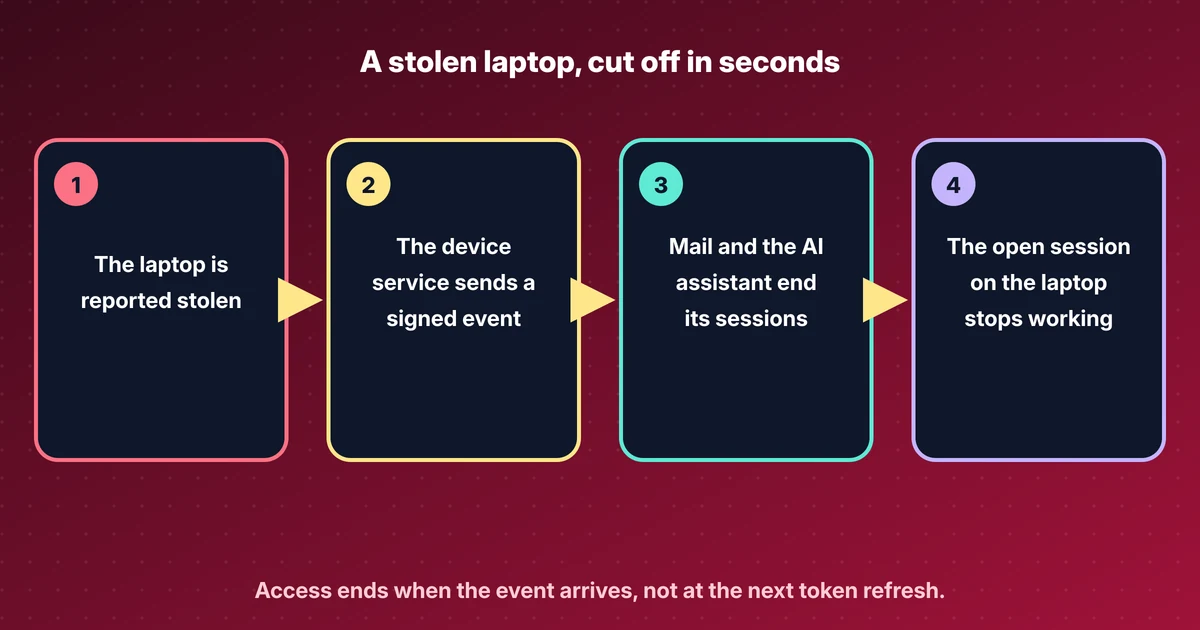
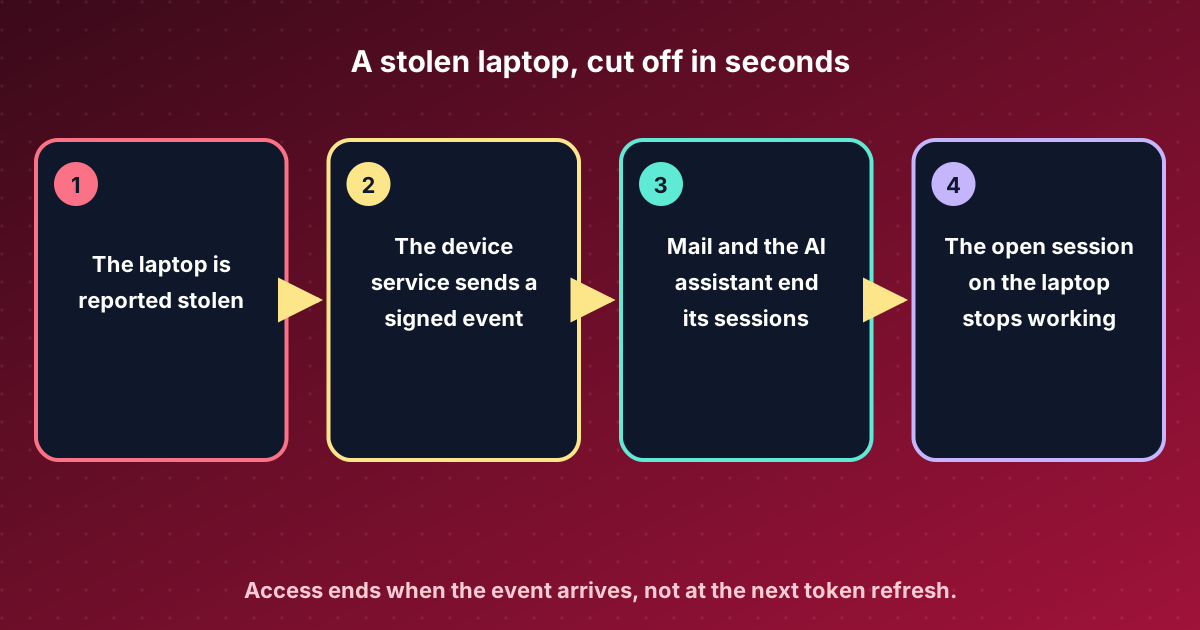
A laptop is stolen from a car. Its owner was signed in to mail, to the team chat and to an AI assistant that can read the calendar and send messages in her name. She reports the theft to the information technology (IT) team ten minutes later, and IT marks the laptop as lost. What happens to those open sessions depends on whether the apps hear about it.
A token outlives the reason it was issued#
Apps do not ask the identity provider on every click. At sign-in they get an access token that is valid for a fixed time, often an hour, and usually a refresh token that keeps the session going for days. Marking the laptop as lost changes a record in the device management service. It does not change the tokens that are already on the laptop.
So until those tokens expire, or until an app happens to check again, whoever holds the laptop can keep using the open sessions. For a person reading mail, an hour is bad. For an AI assistant that sends messages on its own, an hour is a lot of messages.
What Shared Signals adds#
The Shared Signals Framework (SSF) is a standard way for one service to tell others, right away, that something about a user, a session or a device has changed. The service that knows is the transmitter, here the device management service or the identity provider. The apps that care are receivers.
Each receiver sets up a stream with the transmitter once. It says which events it wants, about which users or devices, and where to deliver them. After that, events arrive as they happen, either pushed to the receiver or collected by it at short intervals.
Each event is a small signed message, a Security Event Token. It names who or what the event is about, what happened and when. The receiver checks the signature against the transmitter’s published keys before it acts, so a forged “sign this user out” message does nothing.
CAEP and RISC: what the events say#
SSF is the pipe. Two OpenID profiles define what goes through it. CAEP, the Continuous Access Evaluation Profile, covers sessions and devices: a session was revoked, a device is no longer compliant, a credential changed, the assurance level changed. RISC covers the account itself: disabled, compromised, recovered. SSF, CAEP and RISC 1.0 became OpenID Final Specifications on 2 September 2025.
For the laptop, the device service sends “device compliance changed: not compliant”, and the identity provider follows with “session revoked” for the sessions on that device. Mail, chat and the assistant end those sessions when the events arrive. Her phone keeps working.
What the app on the receiving end has to do#
A receiver is not passive. It has to subscribe the users or devices it cares about, check every event, remember which events it already applied so that a replayed one changes nothing, and then enforce: refuse the old tokens and stop work that is already running. An assistant halfway through sending twenty messages should stop at the next one, not finish the batch.
Two details surprise people. Ending a session does not lock the account: if she should not be able to sign in again, the identity provider has to refuse the sign-in. And an app only receives events for the subjects it subscribed, in the form the transmitter uses to name them.
Where the standards stand#
The three specifications are final. Microsoft’s continuous access evaluation is based on CAEP, Okta can receive SSF events, and Google’s Cross-Account Protection is based on RISC. The working group is still adjusting the profile that vendors test against: on 17 November 2026 it removed the fixed signing algorithm from the CAEP interoperability profile, and an open proposal adds subject formats for agents and workloads.
I built a receiver in front of a Model Context Protocol (MCP) server and cut a running AI agent call with one event in a hands-on lab. The Knowledge article on SSF, CAEP and RISC covers the event types, the token format and who implements what.
Sources#
- OpenID Foundation, 2 Sep 2025: Three Shared Signals Final Specifications Approved
- OpenID Shared Signals Framework Specification 1.0 (Final)
- OpenID Continuous Access Evaluation Profile 1.0 (Final)
- OpenID RISC Profile Specification 1.0 (Final)
- RFC 8417: Security Event Token (SET)
- openid/sharedsignals PR #368, Drop event signatures (merged 17 Nov 2026)
- openid/sharedsignals PR #362, agent and workload as subject (open)
This post as Markdown · RSS · JSON feed
New posts by email
One email a week with new posts and labs. Unsubscribe anytime.
Your address is stored with Kit, which sends the emails. Details