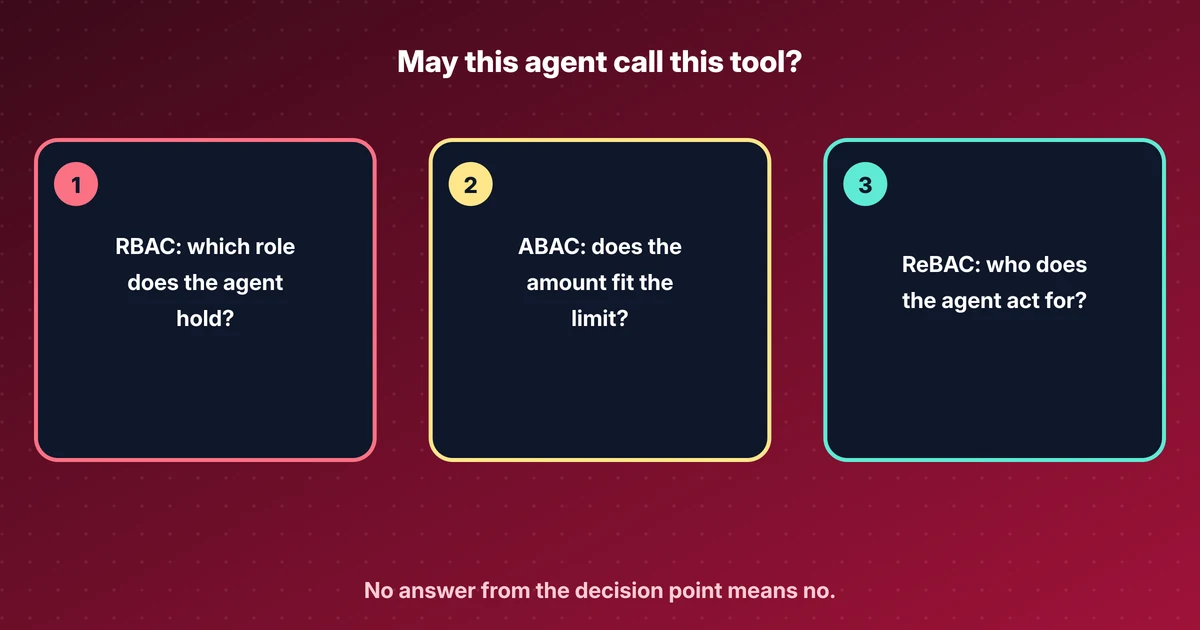
TL;DR
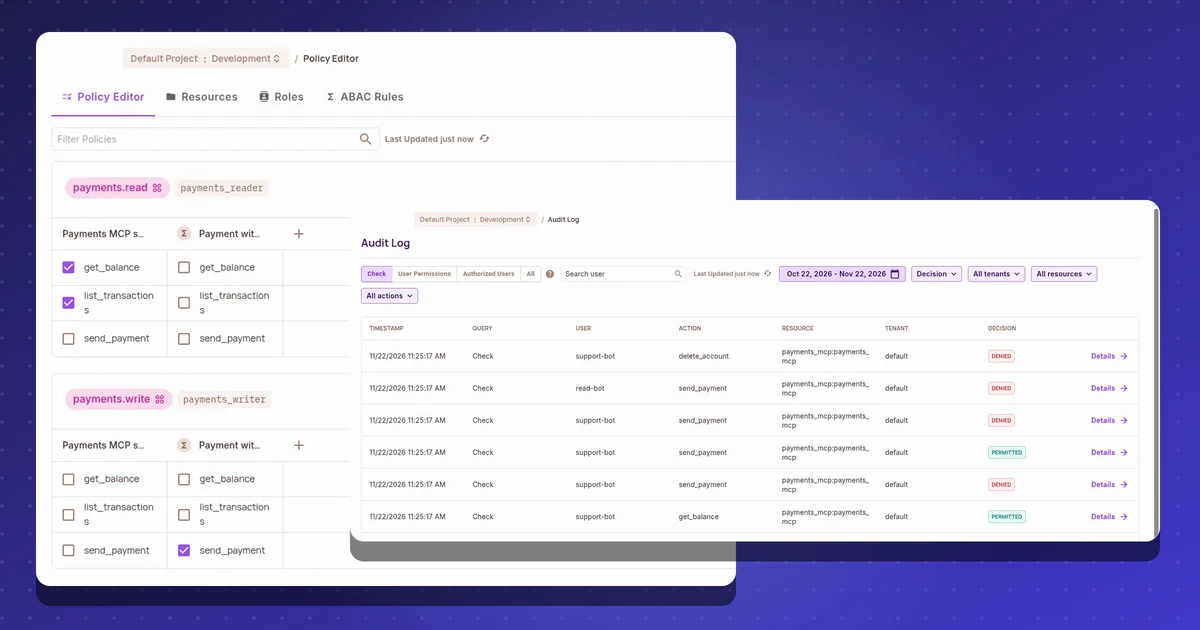
- RBAC (role-based access control) answers from the role an agent holds. It is simple to review, and the Permit.io lab uses roles for the scopes.
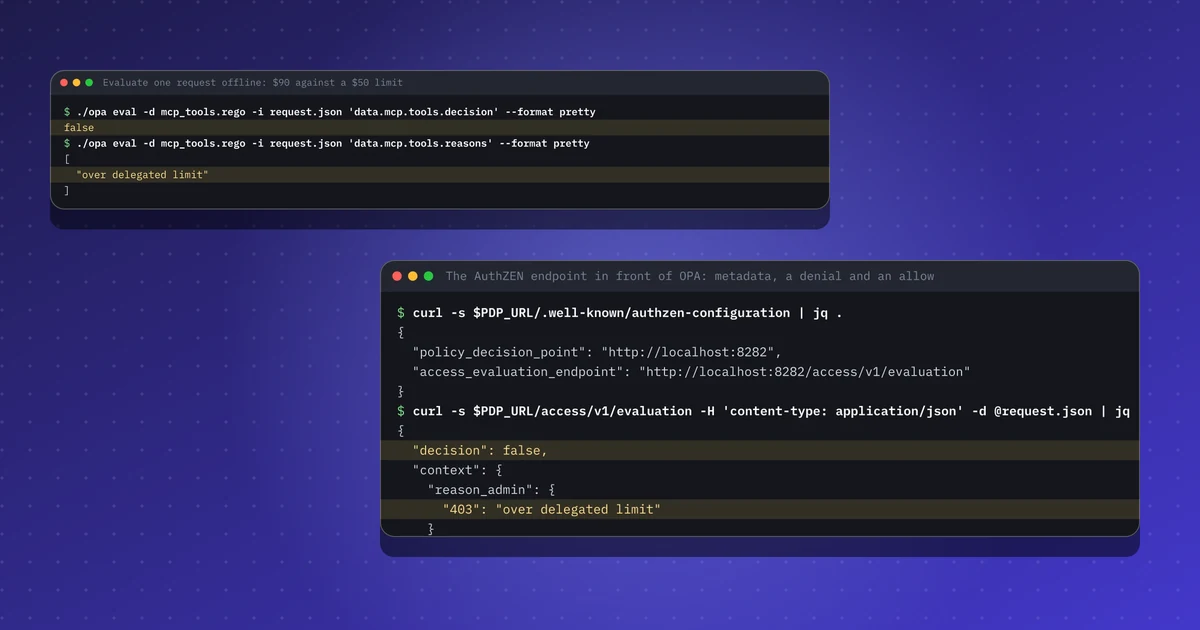
- ABAC (attribute-based access control) answers from facts about the request, such as an amount against a limit. That is how a $90 payment can be refused while a $45 one passes.
- ReBAC (relationship-based access control) answers from relationships: this agent acts for this person, who may use this server. Permit's MCP (Model Context Protocol) Gateway builds its trust ceiling this way.
- Policy is written in one place and evaluated close to the caller. When the decision point does not answer, the enforcement point must refuse, as my lab run shows.
An AI agent asks to call a tool: read a balance, send a payment, delete an account. Something has to say yes or no. In the AuthZEN (the OpenID authorization standard) explainer I described who asks, the policy enforcement point (PEP), and who answers, the policy decision point (PDP). This page is about how the PDP reaches its answer. Most products mix three models, and it helps to know which one a rule belongs to.
RBAC asks what role you have#
Role-based access control gives permissions to roles and roles to identities. An agent with the role “payments reader” may call the two read tools. That is all the PDP needs to know.
RBAC is easy to review: you can print who has which role and what each role allows. It struggles with anything that depends on the request itself. A role cannot say “up to $50”. People then create roles like “payments up to 50”, “payments up to 500”, and the list grows until nobody can review it.
ABAC asks about attributes#
Attribute-based access control decides from facts: about the subject (its delegated limit), the resource (the amount of this payment), the action and the context (did the user confirm, what time is it). A rule reads like “the amount is at or below the agent’s limit, and the user confirmed”.
This is the model for limits and conditions. It is also the one that depends most on the enforcement point, because many attributes arrive with the request. If the agent can write the amount or the confirmation flag itself, the rule protects nothing. The PEP has to fill those values from the session, the token and a confirmation step the model cannot fake.
ReBAC asks how things are related#
Relationship-based access control decides from a graph: this agent acts for this person, this person may use this MCP server, this server belongs to this team. Google described the approach in its Zanzibar paper, and many engines follow it.
ReBAC fits delegation well. Permit’s MCP Gateway uses it to build a trust ceiling: the agent’s level on a server is the lower of what the person granted the agent and what the admin granted the person. An agent can never do more than the person behind it.
Where the decision runs#
Policy is usually written in one place, a control plane, and evaluated somewhere else, a PDP close to the caller. Permit’s Edge PDP, for example, is a container with OPA (Open Policy Agent) inside and an OPAL (Open Policy Administration Layer) client that receives policy and data updates in the background. The control plane is where you change the rules; the PDP keeps answering from its local copy.
That split matters for agents, because tool calls are many and fast. A check over the network to a hosted PDP is simple to start with. A PDP next to the gateway answers faster and keeps working when the hosted side is unreachable.
Not every PDP evaluates every model. In my Permit.io lab the hosted Cloud PDP answered that ABAC is not supported yet and refused a payment that the Edge PDP allowed.
When the decision point does not answer#
A PDP can be missing its key, still starting, overloaded or gone. In each case there is no decision. The PEP must then refuse the call, and log that the refusal came from an error, not from a rule. In my Permit.io lab a keyless PDP answered 401, 403 or 503 depending on the request, and only the enforcement point turned those into a clean deny.
The short version for a product owner: ask your vendor what the gateway does when the policy engine does not answer, and ask to see it tested.
Sources#
- NIST, Role Based Access Control project
- NIST SP 800-162, Guide to Attribute Based Access Control (ABAC) Definition and Considerations
- Google Research, Zanzibar: Google's Consistent, Global Authorization System
- Permit.io docs, Permit MCP Gateway architecture (trust levels and ReBAC)
- Permit.io docs, ABAC design patterns
- Permit.io docs, PDP overview
- OPAL on GitHub
This post as Markdown · RSS · JSON feed
New posts by email
One email a week with new posts and labs. Unsubscribe anytime.
Your address is stored with Kit, which sends the emails. Details