TL;DR
- AuthZEN is the OpenID standard for asking a policy engine whether a request is allowed. Authorization API 1.0 became a Final Specification on 12 January 2026.
- OPA is a CNCF graduated policy engine (since 29 January 2021). You write policy in Rego.
- Cedar is an open-source policy language from Amazon, used in Amazon Verified Permissions, with a permit or forbid decision.
An AI agent needs a yes or no before it edits a contract draft. The code that blocks the call is the Policy Enforcement Point, or PEP. The code that answers the question is the Policy Decision Point, or PDP. Those names come from older access-control models. The practical problem is that every PDP used to speak a different API, so swapping the engine meant rewriting the gateway.
AuthZEN is the OpenID standard for that conversation. OPA and Cedar are two engines that can sit behind it and give the answer.
What AuthZEN standardises#
AuthZEN is a protocol between a PEP and a PDP. The PEP asks whether a subject may perform an action on a resource, in a given context. For the agent, that can be a named agent, the action “edit”, a contract draft, and a context that names the document. The PDP answers true or false. The PEP allows the call only on true. If the PDP is unreachable, the PEP has to treat that as a deny.
The PEP does not need to know how the PDP stores or evaluates policy. Authentication to the Authorization API itself is out of scope of the specification. OAuth 2.0 is recommended.
On 12 January 2026 the OpenID Foundation membership approved Authorization API 1.0 as an OpenID Final Specification (81 approve, 1 object, 25 abstain). A Final Specification gives implementers intellectual property protections and is not subject to further revision. Later work may add methods or optional parameters, but must not modify the 1.0 API.
The working group specifications page also lists drafts that are not final, including a mapping framework called COAZ and a binding for the Model Context Protocol. I mention them only as work in progress. The stable contract today is Authorization API 1.0.
On 20 May 2026, Keycloak announced experimental AuthZEN support from version 26.7, so Keycloak itself can act as a PDP. The feature is experimental and is not a production recommendation.
OPA writes the answer in Rego#
Open Policy Agent is a general-purpose policy engine. It was accepted by the Cloud Native Computing Foundation in 2018 and graduated on 29 January 2021. It is still listed as a CNCF graduated project.
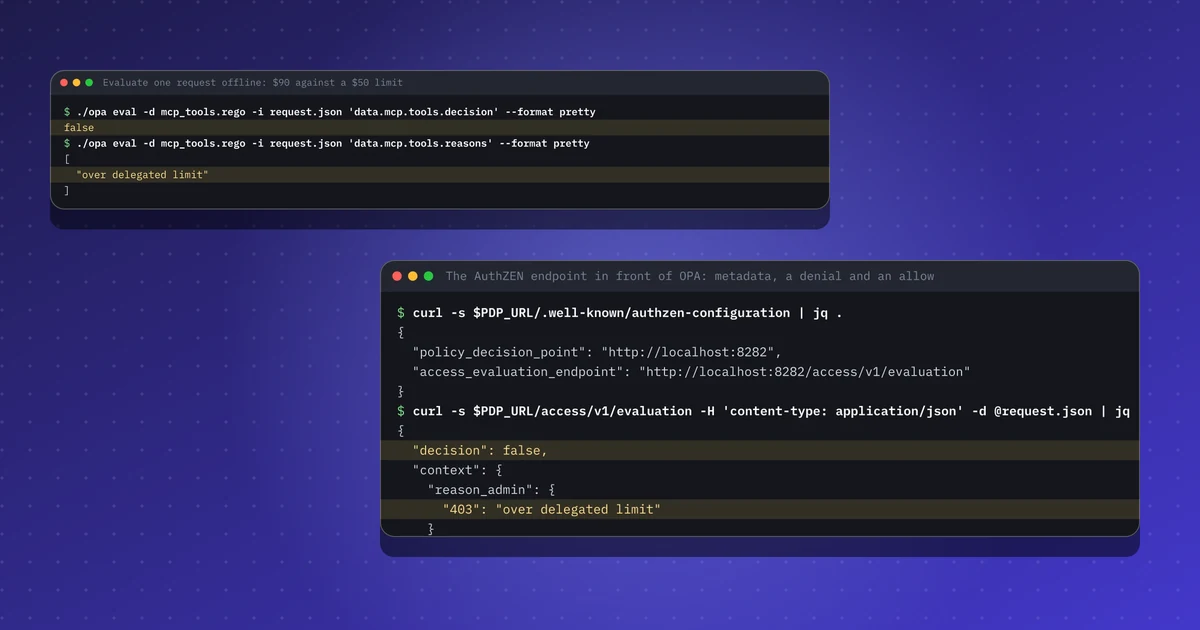
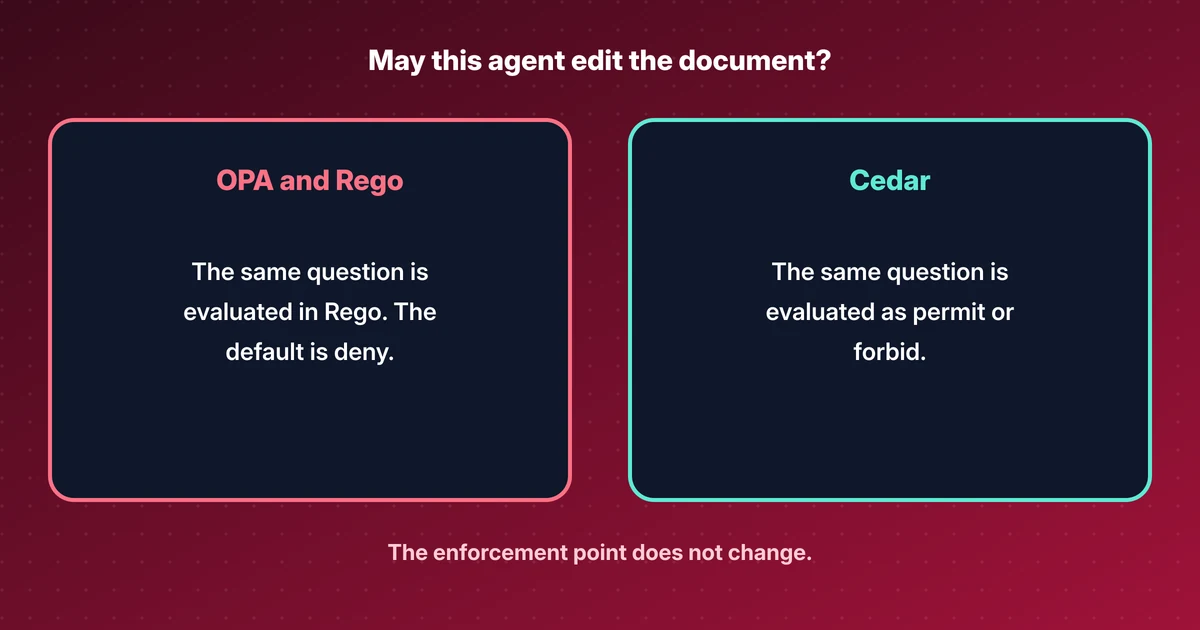
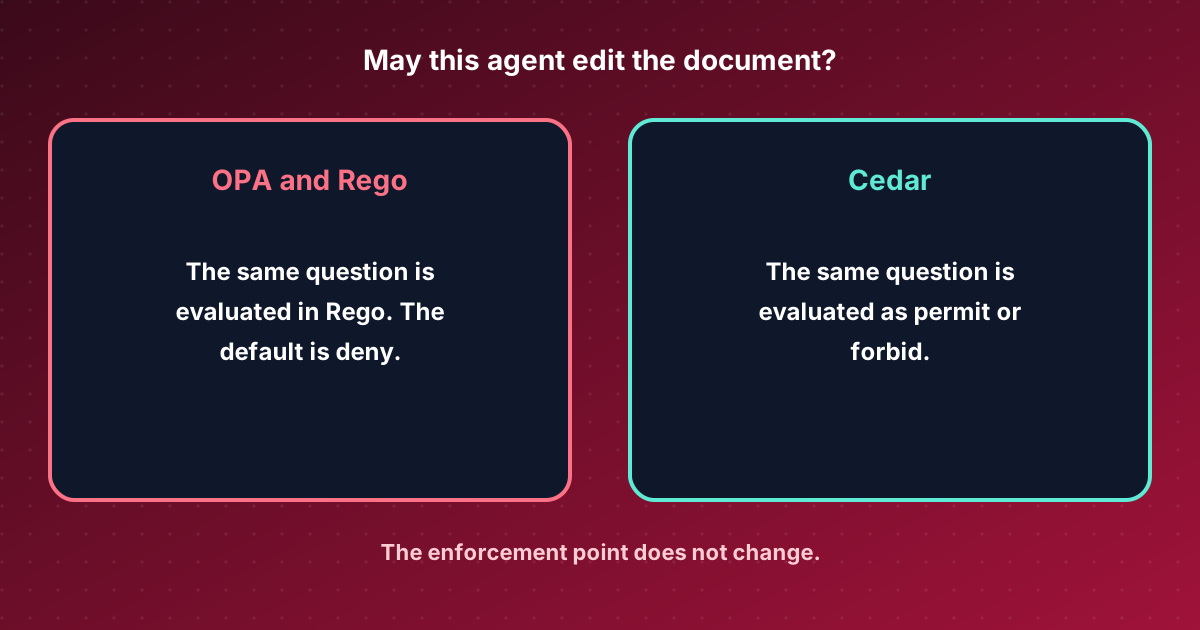
You write policy in Rego. OPA evaluates a request against that policy and returns a decision. The default can be deny, so an unknown action or an edit of a document that is not on the list is refused. The policy lives in a repository and can be tested before it is deployed.
OPA can answer through its own API. It can also sit behind an AuthZEN endpoint, so the PEP still sends the same question and receives the same true or false.
Cedar writes the answer as a permit or a forbid#
Cedar is an open-source policy language and evaluation engine. Amazon released it, and Amazon Verified Permissions uses it as the language for application authorization.
Policies are permit or forbid statements, checked against a schema, so a typo in a resource type is caught before the policy runs. The default is also deny: if no permit matches, or a forbid matches, the decision is deny. Cedar’s brief is narrower than OPA’s, which is often used for admission control, CI checks and API authorization alike. For a document decision, both can express the rule.
The AuthZEN request does not change. A Cedar PDP answers the same question, and the PEP still understands a decision of true or false.
A hands-on lab puts OPA behind an AuthZEN endpoint.
Sources#
- OpenID Foundation, 12 Jan 2026: Authorization API 1.0 Final Specification approved
- OpenID AuthZEN Authorization API 1.0 (Final)
- OpenID AuthZEN Working Group specifications
- Open Policy Agent
- CNCF: Open Policy Agent (graduated 29 January 2021)
- Cedar policy language
- Keycloak, 20 May 2026: experimental AuthZEN support
This post as Markdown · RSS · JSON feed
New posts by email
One email a week with new posts and labs. Unsubscribe anytime.
Your address is stored with Kit, which sends the emails. Details