In breve
- Quando l'agente B chiama l'agente C per conto dell'agente A, B scambia il token di A con uno nuovo. Su Keycloak 26.8.2 lo scope del nuovo token segue gli scope di B, non il token consegnato da A, a meno che si imponga il downscoping.
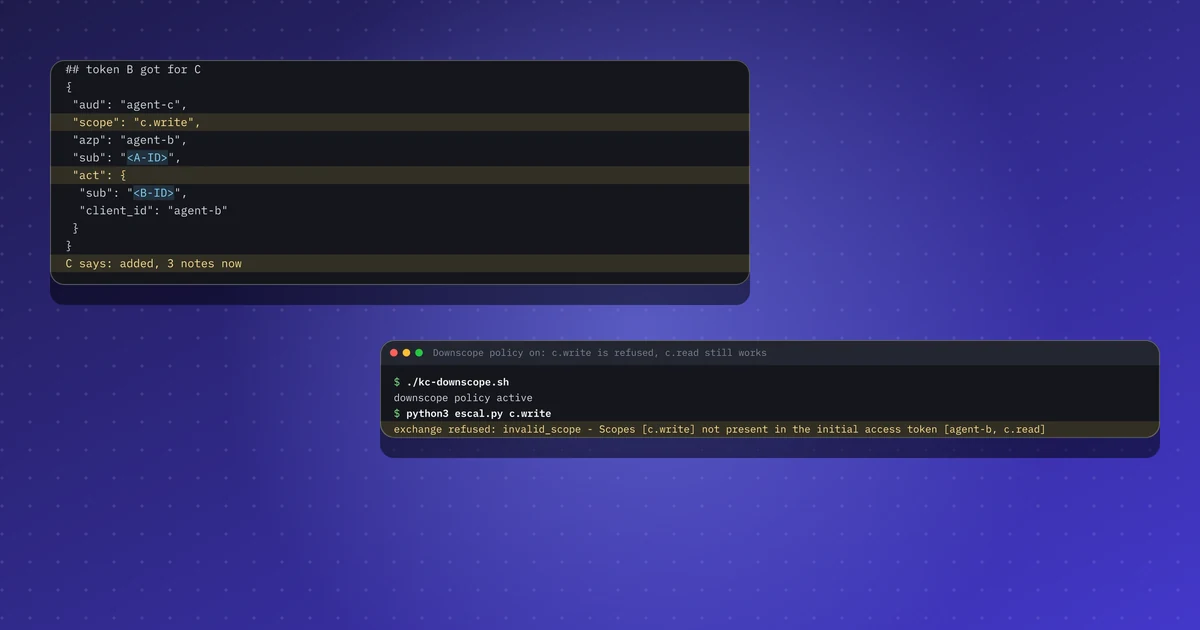
- Nel mio test A aveva c.read, B aveva c.write come scope opzionale proprio, e lo scambio di B ha restituito un token per A con c.write. L'agente C ha accettato una scrittura che A non aveva mai concesso.
- Non è B che esce dai propri limiti: usa un diritto che ha. Con c.write tolto a B lo stesso scambio fallisce con invalid_scope. È una lezione di configurazione, non una vulnerabilità.
- Una client policy con l'executor downscope-assertion-grant-enforcer limita lo scambio agli scope di A. L'agente C dovrebbe anche richiedere il claim act e controllare lo scope per ogni skill.
- Ho provato solo Keycloak. A2A 1.0.0 lascia l'autorizzazione all'implementazione e l'Agent Card non ha un campo per il token exchange.
Ripeti questo lab
Ho scritto questo lab perché tu possa rifarlo per conto tuo. Ogni passo ha i comandi da copiare e l'output che ho ottenuto io, e puoi segnarlo come fatto. Le spunte restano solo nel tuo browser.
Copia un prompt già pronto per Claude Code, Cursor, Codex o un altro agente di codice. Solo per ambienti di test.
Mostra il prompt
I want to run a hands-on lab from iamops.dev, and I would like your help to do it safely.

Lab: Imporre il downscoping nel token exchange per le chiamate tra agenti
Read the whole lab here (Markdown): https://iamops.dev/it/enforce-downscoping-token-exchange-a2a.md

What the lab needs before the first step:
- Keycloak 26.8.2 unpacked and a JDK 21; curl and Python 3.10 or newer
- Port 8080 free; keep this terminal open and use a second one for the next steps
- Values I have to set myself (the lab uses placeholders): <KEYCLOAK_DIR>, <JDK_DIR>, <ADMIN_PASSWORD>, <AGENT_A_SECRET>, <AGENT_B_SECRET>, <AGENT_C_SECRET>

How I want you to work:
1. Read the lab from start to finish first (each step lists its own prerequisites). Then check that the prerequisites are in place and that the tool versions match what the lab expects. Tell me what is missing before you run anything.
2. Run one step at a time. Before each command, show it to me and say in a sentence what it does.
3. Ask me before anything that costs money, creates cloud resources, touches a real tenant or account, or deletes anything. Wait for my answer.
4. Use the placeholders from the lab. Never paste real secrets, tokens or production identities into a command, a file or this chat. If a value is needed, tell me where to set it myself.
5. After each step, compare the output with the expected output in the lab. If it does not match, stop and tell me what differs. Do not carry on or invent a fix without asking me.
6. At the end, report what passed, what failed and which cleanup you did. Then offer to tick the steps off for me. The lab page keeps ticks only in my browser, so if you cannot do that, list the steps I should tick.

This lab is for test environments only. Do not run it against production, or against a tenant or account that holds real data or real users.

You may answer in my language.
A2A 1.0.0 è la versione corrente del protocollo Agent2Agent. Dice che un server deve autenticare ogni richiesta e che l’autorizzazione spetta all’implementazione. Non dice cosa succede quando l’agente B chiama l’agente C per conto dell’agente A. Quella parte è OAuth semplice, e lo strumento abituale è il token exchange (RFC 8693). Ho costruito una piccola catena su un Keycloak locale e mi sono posto una sola domanda: il token che B ottiene per C resta dentro ciò che A ha consegnato?
No, a meno che si chieda a Keycloak di imporlo. Questo articolo parla di quell’impostazione. Se hai letto il primo lab sul token exchange con Keycloak, questo riparte dal punto dell’insidia “nessun claim act” e aggiunge la delega.
Cosa mostra questo lab#
Tre agenti e un server di autorizzazione, tutti su localhost.
- A è il chiamante. Ha un token con scope
agent-b c.read. Un claimmay_actin quel token indica B come parte autorizzata ad agire per lui. - B è un agente nel mezzo. Riceve la chiamata di A, poi chiede a Keycloak un token per chiamare C, usando il token di A come
subject_tokene il proprio comeactor_token. - C è un piccolo agente di note con una skill di lettura e una di scrittura. Accetta solo token delegati e controlla lo scope per ogni skill.
| Client | Ruolo | Scope che può chiedere in uno scambio |
|---|---|---|
agent-a |
Chiamante, service account | agent-b di default, c.read se lo chiede |
agent-b |
Agente intermedio, esegue lo scambio | c.read e c.write, entrambi opzionali |
agent-c |
Agente di note, solo audience | nessuno |
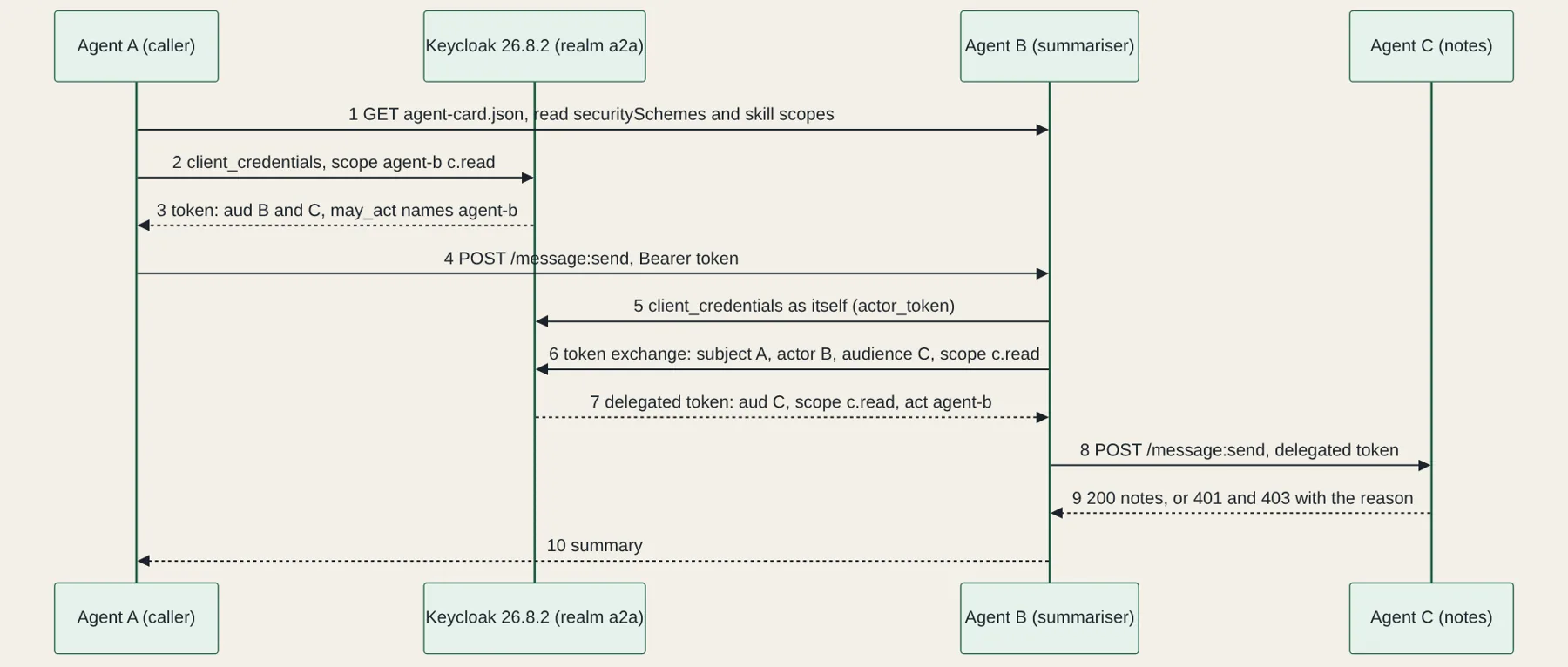
Ogni agente pubblica una Agent Card in /.well-known/agent-card.json con uno schema di sicurezza oauth2 e gli scope per skill. Lo schema può dire clientCredentials e nulla di più vicino al token exchange: un oggetto OAuthFlows contiene esattamente un flusso e non esiste un flusso di scambio. Per questo la card di C lo dice nel testo della descrizione, e chi chiama deve leggerlo.
Configurazione#
Keycloak 26.8.2 dallo zip, Java 21, modalità sviluppo. Lo standard token exchange è attivo di default nella 26.8. La delega, cioè i claim act e may_act, no. Servono due funzioni in anteprima.
"$KC_HOME/bin/kc.sh" start-dev --http-port 8080 --features=token-exchange-delegation,parameterized-scopesKeycloak stampa all’avvio le funzioni in anteprima attivate. Le ho attivate insieme e non le ho provate una per una. Senza di esse la mia catena fallisce: Keycloak rifiuta in uno scambio semplice qualsiasi subject token che porti may_act, con “Subject token with a delegation claim is not allowed for standard token exchange”.

Lo script del realm crea i tre client con service account, gli scope agent-b, c.read e c.write (ciascuno con un audience mapper) e un mapper may_act fisso su agent-a. Attiva anche lo Standard Token Exchange per agent-b e dà a agent-b gli scope c.read e c.write come client scope opzionali. Ricorda quest’ultimo punto. Tutto l’articolo gira attorno a questo.
La catena funziona#
A legge la card di B, chiede a Keycloak esattamente gli scope elencati dalla skill e invia message:send. B scambia il token e chiama C. Il token delegato decodificato mantiene A come sub, restringe aud a C, porta solo c.read e aggiunge act per B.

Lo scambio che A non aveva concesso#
Ora B chiede c.write. Il token di A non ha c.write. Ecco la richiesta, con segnaposto:
curl -s "$KC_URL/realms/a2a/protocol/openid-connect/token" \
  -d grant_type=urn:ietf:params:oauth:grant-type:token-exchange \
  -d client_id=agent-b -d "client_secret=$AGENT_B_SECRET" \
  -d subject_token="$A_TOKEN" -d subject_token_type=urn:ietf:params:oauth:token-type:access_token \
  -d actor_token="$B_TOKEN" -d actor_token_type=urn:ietf:params:oauth:token-type:access_token \
  -d audience=agent-c -d scope=c.write
Keycloak emette il token. sub è A, act indica B, scope è c.write. C controlla firma, audience, il claim act e lo scope richiesto dalla sua skill di scrittura, e aggiunge la nota.
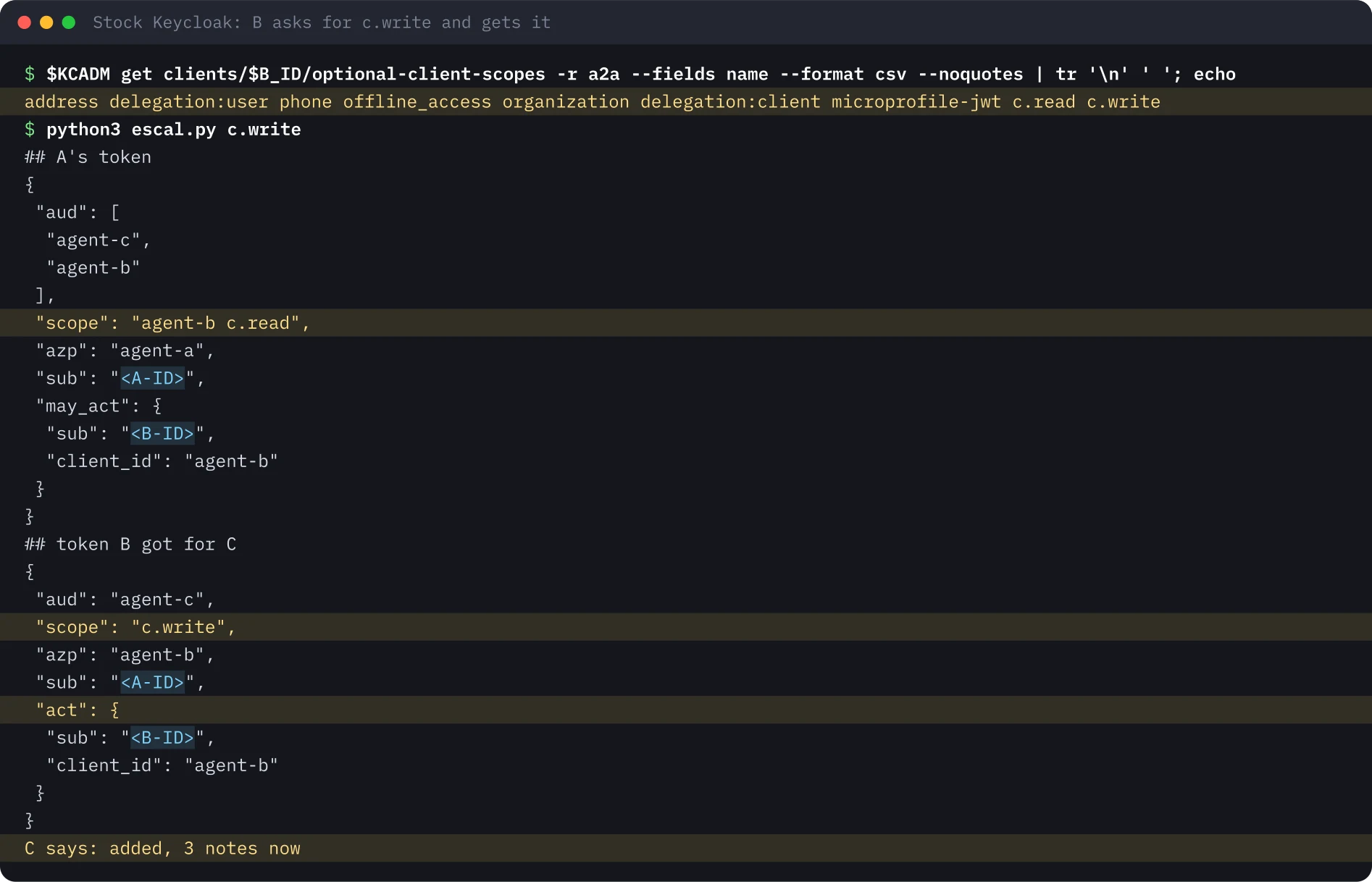
Ho eseguito l’intera sequenza quattro volte su un Keycloak 26.8.2 nuovo, due con gli script del lab e due con quelli di questo articolo, e il risultato è stato sempre lo stesso.
Il controllo: B possiede c.write#
Prima di chiamarla escalation ho verificato di chi è il diritto usato. Nel mio realm B ha c.write come scope opzionale proprio. L’ho messo io. Quindi B non ha ottenuto qualcosa che non gli era mai stato permesso. Ho tolto c.write dagli scope opzionali di B e ho ripetuto lo stesso scambio.

Questo chiarisce una cosa. B non può andare oltre ciò che possiede, e qui non c’è un bug nel senso di un aggiramento. Quello che è andato perso è altro: lo scope del nuovo token è limitato dall’insieme di scope di B e non dal token di A. A aveva detto “lettura”, e un passaggio dopo questo non significava più nulla. L’RFC 8693 lascia la scelta al server: scope è “the desired scope of the requested security token” e i suoi valori sono “service specific” (sezione 2.1). Nulla impone che il risultato sia un sottoinsieme del subject token.
Per gli agenti conta perché C registra sub A e act B. Chi legge il log vede “A ha scritto una nota”. A non aveva mai accettato.
Limitare lo scambio con la policy di downscope#
Keycloak ha un executor per le client policy fatto apposta: downscope-assertion-grant-enforcer. Limita gli scope del nuovo token a quelli già presenti nel subject token e risponde invalid_scope negli altri casi. Non richiede configurazione. L’ho applicato a tutti i client del realm con una sola policy.
{"profiles":[{"name":"downscope-only","description":"exchange can narrow, never widen",
  "executors":[{"executor":"downscope-assertion-grant-enforcer","configuration":{}}]}]}
Con c.write di nuovo su B e la policy attiva, lo scambio viene rifiutato. Lo scambio legittimo con c.read funziona ancora.
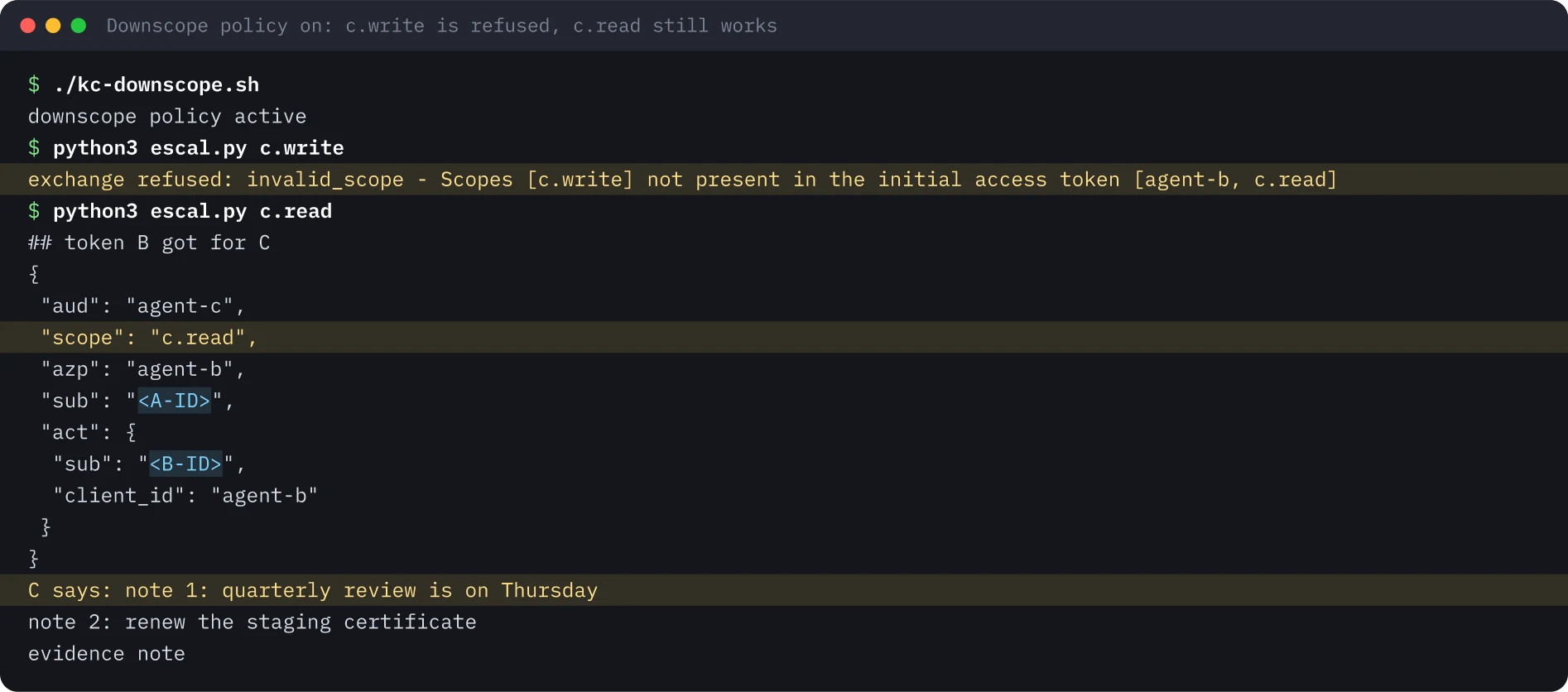
L’ultima riga di quell’output è la nota aggiunta dalla prova standard. Resta finché non riavvii C.
Cosa deve controllare anche C#
La policy vive sul server di autorizzazione. C non dovrebbe dipendere solo da quella.
- Richiedi il claim
acte confrontaact.client_idcon gli agenti che ti aspetti. Il mio C risponde 403 senza. - Controlla lo scope per skill. Il mio C richiede
c.readper leggere ec.writeper scrivere. - Controlla
aud. Un token per B viene rifiutato da C con 401. - Non trattare
may_actcome una prova. Quando B ha presentato il token di C come attore, Keycloak ha rifiutato con un messaggio sull’audience. Non ho verificato se confronti l’attore conmay_act.
Insidie#
- L’enforcer e un audience mapper a livello di client. Nella mia prima configurazione l’audience di C stava in un mapper sul client B. Con l’enforcer attivo ogni scambio falliva con “Requested audience not available: agent-c”. Spostare il mapper sugli scope
c.readec.writeha risolto. Non so perché. Provalo nel tuo realm. - L’audience tramite scope ha un effetto collaterale.
c.readporta l’audience di C, quindi il token di A haaudB e C. Ciò che impedisce ad A di usarlo su C è il requisitoact, non l’audience. - L’errore sull’attore sbagliato è vago. Il client vede
access_deniede “Client is not within the token audience”. Il log eventi di Keycloak nomina l’attore. may_actè fisso nel mio realm. In un sistema reale dovrebbe derivare da una policy e vivere insieme al token.
Cosa non ho eseguito#
Ho eseguito solo Keycloak 26.8.2. Non ho provato Entra on-behalf-of, Okta né Auth0, quindi non dico nulla su come limitino lo scope in uno scambio. Un solo passaggio di delega: nessuna catena act annidata. Nessun task, streaming o Agent Card firmata, nessun TLS e nessun token vincolato al mittente. Nessun utente nella catena: il soggetto è il service account dell’agente A. Gli agenti sono miei programmi Flask e i loro client secret sono valori statici di laboratorio.
Le immagini del terminale sono state ricostruite dall’output salvato delle esecuzioni, con gli id sostituiti da segnaposto. Niente di quanto vedi è una credenziale reale.
Per gli standard alla base, vedi ID-JAG spiegato e perché un server MCP non deve inoltrare i token.
Ripeti questo lab#
Circa 40 minuti su un portatile: un Keycloak locale con due funzioni in anteprima, uno script per il realm, tre piccoli agenti in Python e tre scambi: standard, di controllo e con la policy di downscope. Apri ogni passo, copia i blocchi e confronta il tuo output con quello atteso.
Ogni valore tra parentesi angolari è un segnaposto per il tuo ambiente di test. Nulla in questa pagina è un identificativo o un segreto reale.
Imposta le variabili una sola volta
# Paste into every terminal you use for this lab. Replace each <PLACEHOLDER> with a throwaway value of your own.
export KC_HOME='<KEYCLOAK_DIR>'          # the unpacked keycloak-26.8.2 folder
export JAVA_HOME='<JDK_DIR>'             # a JDK 21
export KC_URL="http://localhost:8080"
export KC_ADMIN_USER="admin"
export KC_ADMIN_PASSWORD='<ADMIN_PASSWORD>'
export AGENT_A_SECRET='<AGENT_A_SECRET>'
export AGENT_B_SECRET='<AGENT_B_SECRET>'
export AGENT_C_SECRET='<AGENT_C_SECRET>'
0 di 8 passi fatti
Passo 1Avvia Keycloak con le funzioni di delega
Obiettivo. Esegui un server di autorizzazione locale con token-exchange-delegation e parameterized-scopes, le due funzioni in anteprima che aggiungono il claim act.
Prerequisiti
- Keycloak 26.8.2 scompattato e un JDK 21; curl e Python 3.10 o successivo
- Porta 8080 libera; lascia aperto questo terminale e usane un secondo per i passi successivi
export KC_BOOTSTRAP_ADMIN_USERNAME="$KC_ADMIN_USER" KC_BOOTSTRAP_ADMIN_PASSWORD="$KC_ADMIN_PASSWORD"
"$KC_HOME/bin/kc.sh" start-dev --http-port 8080 --features=token-exchange-delegation,parameterized-scopes
Output atteso
INFO  [org.keycloak.common.Profile] (main) Preview features enabled: parameterized-scopes:v1, token-exchange-delegation:v1
WARN  [org.keycloak.common.Profile] (main) Deprecated features identity-brokering-api:v1, twitter-broker:v1 enabled by default. Check the upgrading guide for steps to use later versions if available.
INFO [io.quarkus] (main) Keycloak 26.8.2 on JVM (powered by Quarkus 3.40.1.1) started in 16.223s. Listening on: http://localhost:8080Passo 2Crea il realm, i client e il claim may_act
Obiettivo. Crea il realm a2a: tre client con service account, tre scope con audience e un mapper che mette may_act nel token di A. B riceve c.read e c.write come scope opzionali.
Prerequisiti
- Il blocco env impostato in questo terminale; Keycloak del passo precedente ancora in esecuzione
- Lo script richiede circa un minuto perché riduce gli scope predefiniti di ogni client
#!/usr/bin/env bash
# Realm "a2a": three agents as clients with service accounts, scopes with audiences, and a may_act claim that names the actor.
set -euo pipefail
: "${KC_HOME:?}" "${JAVA_HOME:?}" "${KC_ADMIN_PASSWORD?}" "${AGENT_A_SECRET:?}" "${AGENT_B_SECRET:?}" "${AGENT_C_SECRET:?}"
KCADM="$KC_HOME/bin/kcadm.sh"
$KCADM config credentials --server "${KC_URL:-http://localhost:8080}" --realm master --user "${KC_ADMIN_USER:-admin}" --password "$KC_ADMIN_PASSWORD" >/dev/null
$KCADM create realms -s realm=a2a -s enabled=true -s sslRequired=none >/dev/null
scope() { # name audience
  $KCADM create client-scopes -r a2a -s name="$1" -s protocol=openid-connect -s 'attributes."include.in.token.scope"=true' >/dev/null
  local id; id=$($KCADM get client-scopes -r a2a --fields id,name --format csv --noquotes | awk -F, -v n="$1" '$2==n{print $1}')
  $KCADM create client-scopes/$id/protocol-mappers/models -r a2a -s name="aud-$2" -s protocol=openid-connect -s protocolMapper=oidc-audience-mapper \
    -s "config.\"included.client.audience\"=$2" -s 'config."access.token.claim"=true' -s 'config."id.token.claim"=false' >/dev/null
  echo "$id"
}
S_B=$(scope agent-b agent-b); S_CR=$(scope c.read agent-c); S_CW=$(scope c.write agent-c)
agent() { # client id, secret
  $KCADM create clients -r a2a -s clientId="$1" -s secret="$2" -s publicClient=false -s serviceAccountsEnabled=true \
    -s standardFlowEnabled=false -s directAccessGrantsEnabled=false >/dev/null
  $KCADM get clients -r a2a -q clientId="$1" --fields id --format csv --noquotes
}
A=$(agent agent-a "$AGENT_A_SECRET"); B=$(agent agent-b "$AGENT_B_SECRET"); C=$(agent agent-c "$AGENT_C_SECRET")
# keep the tokens small: drop the default profile, email and roles scopes from every agent
for CID in $A $B $C; do
  for SN in roles profile email web-origins acr basic; do
    SID=$($KCADM get client-scopes -r a2a --fields id,name --format csv --noquotes | awk -F, -v n="$SN" '$2==n{print $1}')
    [ -n "$SID" ] && $KCADM delete clients/$CID/default-client-scopes/$SID -r a2a >/dev/null 2>&1 || true
  done
done
# agent-b performs the exchange
$KCADM update clients/$B -r a2a -s 'attributes."standard.token.exchange.enabled"=true' >/dev/null
SA_B=$($KCADM get clients/$B/service-account-user -r a2a --fields id --format csv --noquotes)
# agent-a: may call agent-b by default, may add c.read when it asks for it
$KCADM update clients/$A/default-client-scopes/$S_B -r a2a >/dev/null
$KCADM update clients/$A/optional-client-scopes/$S_CR -r a2a >/dev/null
# the claim value is JSON, so pass the mapper as a file; kcadm -s cannot carry nested quotes
MAP=$(mktemp)
cat > "$MAP" <<JSON
{"name":"may-act-agent-b","protocol":"openid-connect","protocolMapper":"oidc-hardcoded-claim-mapper",
 "config":{"claim.name":"may_act","claim.value":"{\"sub\":\"$SA_B\",\"client_id\":\"agent-b\"}","jsonType.label":"JSON",
           "access.token.claim":"true","id.token.claim":"false"}}
JSON
$KCADM create clients/$A/protocol-mappers/models -r a2a -f "$MAP" >/dev/null; rm -f "$MAP"
# agent-b: its own token is the actor token; c.read and c.write are optional scopes it can ask for in an exchange
$KCADM update clients/$B/optional-client-scopes/$S_CR -r a2a >/dev/null
$KCADM update clients/$B/optional-client-scopes/$S_CW -r a2a >/dev/null
echo "realm a2a ready"chmod +x kc-realm.sh
./kc-realm.sh 2>&1 | grep -v "^Created\|^Logging"Output atteso
realm a2a readyPasso 3Salva e avvia l’agente B e l’agente C
Obiettivo. Quattro piccoli file Python: una libreria comune, l’agente C (note, accetta solo token delegati), l’agente B (fa lo scambio) e l’agente A (il chiamante). Avvia B e C e leggi l’Agent Card di C.
Prerequisiti
- Python 3.10 o successivo; porte 19402 e 19403 libere
- Salva i quattro file in una cartella, la stessa di kc-realm.sh
import json, os, urllib.error, urllib.parse, urllib.request, uuid
import jwt
from flask import Flask, Response, request

KC_URL = os.environ.get("KC_URL", "http://localhost:8080")
ISS = f"{KC_URL}/realms/a2a"
TOKEN_URL = f"{ISS}/protocol/openid-connect/token"
JWKS = jwt.PyJWKClient(f"{ISS}/protocol/openid-connect/certs")
MEDIA = "application/a2a+json"
AT = "urn:ietf:params:oauth:token-type:access_token"


class Reject(Exception):
    def __init__(self, http, status, reason, message):
        self.http, self.status, self.reason, self.message = http, status, reason, message


def error_body(r):
    return {"error": {"code": r.http, "status": r.status, "message": r.message,
                      "details": [{"@type": "type.googleapis.com/google.rpc.ErrorInfo", "reason": r.reason, "domain": "a2a-protocol.org"}]}}


def verify(auth_header, my_audience):
    if not auth_header or not auth_header.lower().startswith("bearer "):
        raise Reject(401, "UNAUTHENTICATED", "MISSING_TOKEN", "bearer token required")
    token = auth_header[7:].strip()
    try:
        key = JWKS.get_signing_key_from_jwt(token).key
        return jwt.decode(token, key, algorithms=["RS256"], audience=my_audience, issuer=ISS,
                          options={"require": ["exp", "iss", "aud", "sub"]})
    except jwt.InvalidAudienceError:
        raise Reject(401, "UNAUTHENTICATED", "WRONG_AUDIENCE", f"token is not meant for {my_audience}")
    except jwt.PyJWTError as e:
        raise Reject(401, "UNAUTHENTICATED", "INVALID_TOKEN", f"token rejected: {type(e).__name__}")


def scopes(claims):
    return set((claims.get("scope") or "").split())


def secret_of(client_id):
    return os.environ[client_id.upper().replace("-", "_") + "_SECRET"]


def post_form(data):
    req = urllib.request.Request(TOKEN_URL, data=urllib.parse.urlencode(data).encode())
    try:
        with urllib.request.urlopen(req) as r:
            return json.load(r)
    except urllib.error.HTTPError as e:
        return {"http_status": e.code, **json.load(e)}


def client_credentials(client_id, scope=None):
    d = {"grant_type": "client_credentials", "client_id": client_id, "client_secret": secret_of(client_id)}
    if scope:
        d["scope"] = scope
    return post_form(d)


def exchange(client_id, subject_token, actor_token, audience, scope):
    d = {"grant_type": "urn:ietf:params:oauth:grant-type:token-exchange", "client_id": client_id,
         "client_secret": secret_of(client_id), "subject_token": subject_token, "subject_token_type": AT,
         "audience": audience, "scope": scope}
    if actor_token:
        d.update(actor_token=actor_token, actor_token_type=AT)
    return post_form(d)


def fetch_card(base):
    with urllib.request.urlopen(f"{base}/.well-known/agent-card.json") as r:
        return json.load(r)


def send_message(base, token, text):
    body = {"message": {"messageId": str(uuid.uuid4()), "role": "ROLE_USER", "parts": [{"text": text}]}}
    h = {"Content-Type": MEDIA, "A2A-Version": "1.0"}
    if token:
        h["Authorization"] = f"Bearer {token}"
    req = urllib.request.Request(f"{base}/message:send", data=json.dumps(body).encode(), headers=h, method="POST")
    try:
        with urllib.request.urlopen(req) as r:
            return r.status, json.load(r)
    except urllib.error.HTTPError as e:
        return e.code, json.load(e)


def reply(text):
    return {"message": {"messageId": str(uuid.uuid4()), "role": "ROLE_AGENT", "parts": [{"text": text}]}}


def claims_unverified(token):
    import base64
    p = token.split(".")[1]
    return json.loads(base64.urlsafe_b64decode(p + "=" * (-len(p) % 4)))


def serve(name, port, card, handle):
    app = Flask(name)
    out = lambda obj, status=200: Response(json.dumps(obj), status=status, mimetype=MEDIA)
    app.get("/.well-known/agent-card.json")(lambda: out(card))

    @app.post("/message:send")
    def send():
        try:
            return out(reply(handle(request)))
        except Reject as r:
            print(f"AUDIT {name}: DENIED {r.http} {r.reason}", flush=True)
            return out(error_body(r), r.http)
app.run(port=port)import os
from a2alib import *
PORT = int(os.environ.get("C_PORT", "19403"))
NOTES = ["note 1: quarterly review is on Thursday", "note 2: renew the staging certificate"]
need = lambda s: [{"schemes": {"keycloak": {"list": [s]}}}]
CARD = {
"name": "agent-c notes", "description": "Keeps a short list of notes. Reads and writes need a delegated token.", "version": "1.0.0",
"supportedInterfaces": [{"url": f"http://localhost:{PORT}", "protocolBinding": "HTTP+JSON", "protocolVersion": "1.0"}],
"capabilities": {"streaming": False, "pushNotifications": False},
"defaultInputModes": ["text/plain"], "defaultOutputModes": ["text/plain"],
"securitySchemes": {"keycloak": {"oauth2SecurityScheme": {
"description": "Tokens come from Keycloak via RFC 8693 token exchange, with an actor token. The scheme types below cannot say that, so this text does.",
"oauth2MetadataUrl": f"{ISS}/.well-known/oauth-authorization-server",
"flows": {"clientCredentials": {"tokenUrl": TOKEN_URL, "scopes": {"c.read": "read notes", "c.write": "add notes"}}}}}},
"skills": [
{"id": "read-notes", "name": "Read notes", "description": "Say 'read' to get all notes.", "tags": ["notes"], "securityRequirements": need("c.read")},
{"id": "add-note", "name": "Add a note", "description": "Say 'write: <text>' to add one.", "tags": ["notes"], "securityRequirements": need("c.write")}],
}
def handle(req):
c = verify(req.headers.get("Authorization"), "agent-c")
act = c.get("act") or {}
if act.get("client_id") != "agent-b":
raise Reject(403, "PERMISSION_DENIED", "ACTOR_REQUIRED", "a delegated token from agent-b is required")
text = req.get_json(force=True)["message"]["parts"][0]["text"].strip()
skill = "c.write" if text.startswith("write:") else "c.read"
if skill not in scopes(c):
raise Reject(403, "PERMISSION_DENIED", "INSUFFICIENT_SCOPE", f"skill needs scope {skill}")
print(f"AUDIT c: sub={c['sub'][:8]} actor={act['client_id']} scope='{c.get('scope')}' skill={skill}", flush=True)
if skill == "c.write":
NOTES.append(text[6:].strip())
return f"added, {len(NOTES)} notes now"
return "\n".join(NOTES)
serve("c", PORT, CARD, handle)import os
from a2alib import *
PORT, C_BASE = int(os.environ.get("B_PORT", "19402")), os.environ.get("C_BASE", "http://localhost:19403")
need = lambda *s: [{"schemes": {"keycloak": {"list": list(s)}}}]
CARD = {
"name": "agent-b summariser", "description": "Reads the notes through agent C and sums them up.", "version": "1.0.0",
"supportedInterfaces": [{"url": f"http://localhost:{PORT}", "protocolBinding": "HTTP+JSON", "protocolVersion": "1.0"}],
"capabilities": {"streaming": False, "pushNotifications": False},
"defaultInputModes": ["text/plain"], "defaultOutputModes": ["text/plain"],
"securitySchemes": {"keycloak": {"oauth2SecurityScheme": {
"oauth2MetadataUrl": f"{ISS}/.well-known/oauth-authorization-server",
"flows": {"clientCredentials": {"tokenUrl": TOKEN_URL, "scopes": {"agent-b": "call agent B", "c.read": "allow B to read notes for you"}}}}}},
"skills": [{"id": "summarize", "name": "Summarise notes", "description": "Say 'summarize'.", "tags": ["notes"], "securityRequirements": need("agent-b", "c.read")}],
}
def handle(req):
bearer = req.headers.get("Authorization")
c = verify(bearer, "agent-b")
for s in ("agent-b", "c.read"):
if s not in scopes(c):
raise Reject(403, "PERMISSION_DENIED", "INSUFFICIENT_SCOPE", f"skill needs scope {s}")
actor = client_credentials("agent-b")["access_token"]
ex = exchange("agent-b", bearer[7:].strip(), actor, audience="agent-c", scope="c.read")
if "access_token" not in ex:
raise Reject(502, "UNAVAILABLE", "EXCHANGE_FAILED", f"token exchange refused: {ex.get('error_description')}")
print(f"AUDIT b: exchanged for sub={c['sub'][:8]} scope='{ex['scope']}'", flush=True)
code, body = send_message(C_BASE, ex["access_token"], "read")
if code != 200:
raise Reject(502, "UNAVAILABLE", "DOWNSTREAM_REFUSED", f"agent C said {code}")
notes = body["message"]["parts"][0]["text"].splitlines()
return f"{len(notes)} notes. First: {notes[0]}"
serve("b", PORT, CARD, handle)import json, sys
from a2alib import *
B = "http://localhost:19402"
card = fetch_card(B)
skill = card["skills"][0]
want = skill["securityRequirements"][0]["schemes"]["keycloak"]["list"]
flow = card["securitySchemes"]["keycloak"]["oauth2SecurityScheme"]["flows"]["clientCredentials"]
print(f"card says: skill '{skill['id']}' needs scopes {want}, token endpoint {flow['tokenUrl'].split('/realms/')[1]}")
tok = client_credentials("agent-a", " ".join(want))
claims = claims_unverified(tok["access_token"])
print(f"token: aud={claims['aud']} scope='{claims['scope']}' may_act={claims['may_act']['client_id']}")
code, body = send_message(B, tok["access_token"], sys.argv[1] if len(sys.argv) > 1 else "summarize")
print(code, body["message"]["parts"][0]["text"] if code == 200 else json.dumps(body))python3 -m venv .venv && . .venv/bin/activate
pip install -q "PyJWT==2.15.1" "Flask==3.1.3" "cryptography==50.0.2"
nohup python3 agent_c.py > c.log 2>&1 &
nohup python3 agent_b.py > b.log 2>&1 &
sleep 3
curl -s localhost:19403/.well-known/agent-card.json | python3 -c "import sys,json;c=json.load(sys.stdin);print(c['name']);print(list(c['securitySchemes']));print(c['skills'][0]['securityRequirements'])"Output atteso
agent-c notes
['keycloak']
[{'schemes': {'keycloak': {'list': ['c.read']}}}]Passo 4Chiama la catena come agente A
Obiettivo. A legge la card di B, chiede a Keycloak gli scope elencati dalla skill e invia un messaggio. B scambia il token di A con un token per C e legge le note.
Prerequisiti
- Passi da 1 a 3 completati, nello stesso ambiente virtuale
python3 agent_a.pyOutput atteso
card says: skill 'summarize' needs scopes ['agent-b', 'c.read'], token endpoint a2a/protocol/openid-connect/token
token: aud=['agent-c', 'agent-b'] scope='agent-b c.read' may_act=agent-b
200 2 notes. First: note 1: quarterly review is on ThursdayPasso 5Chiedi c.write su Keycloak standard
Obiettivo. B scambia il token di A e chiede c.write. Il token di A ha solo c.read. Leggi prima gli scope opzionali di B, poi guarda cosa emette Keycloak e cosa ne fa C.
Prerequisiti
- Passi da 1 a 4 completati; è la configurazione standard, ancora senza policy
- Salva escal.py dal blocco qui sotto accanto agli altri file
import json, sys
from a2alib import *

scope = sys.argv[1]
KEYS = ("aud", "scope", "azp", "sub", "may_act", "act")
show = lambda t: json.dumps({k: claims_unverified(t)[k] for k in KEYS if k in claims_unverified(t)}, indent=1)
a = client_credentials("agent-a", "agent-b c.read")["access_token"]
b = client_credentials("agent-b")["access_token"]
print("## A's token\n" + show(a))
ex = exchange("agent-b", a, b, "agent-c", scope)
if "access_token" not in ex:
    sys.exit(f"exchange refused: {ex['error']} - {ex['error_description']}")
print("## token B got for C\n" + show(ex["access_token"]))
text = "write: evidence note" if scope == "c.write" else "read"
code, body = send_message("http://localhost:19403", ex["access_token"], text)
print("C says:", body["message"]["parts"][0]["text"] if code == 200 else f"{code} {body['error']['details'][0]['reason']}")KCADM="$KC_HOME/bin/kcadm.sh"
$KCADM config credentials --server "$KC_URL" --realm master --user "$KC_ADMIN_USER" --password "$KC_ADMIN_PASSWORD"
B_ID=$($KCADM get clients -r a2a -q clientId=agent-b --fields id --format csv --noquotes)
CW_ID=$($KCADM get client-scopes -r a2a --fields id,name --format csv --noquotes | awk -F, '$2=="c.write"{print $1}')
$KCADM get clients/$B_ID/optional-client-scopes -r a2a --fields name --format csv --noquotes | tr '\n' ' '; echo
python3 escal.py c.writeOutput atteso
address delegation:user phone offline_access organization delegation:client microprofile-jwt c.read c.write
## A's token
{
 "aud": [
  "agent-c",
  "agent-b"
 ],
 "scope": "agent-b c.read",
 "azp": "agent-a",
 "sub": "<A-ID>",
 "may_act": {
  "sub": "<B-ID>",
  "client_id": "agent-b"
 }
}
## token B got for C
{
 "aud": "agent-c",
 "scope": "c.write",
 "azp": "agent-b",
 "sub": "<A-ID>",
 "act": {
  "sub": "<B-ID>",
  "client_id": "agent-b"
 }
}
C says: added, 3 notes nowPasso 6Controllo: togli c.write a B
Obiettivo. Rimuovi c.write dagli scope opzionali di B e ripeti lo stesso scambio. Se fallisce, B stava usando un diritto che possiede. Poi rimetti lo scope.
Prerequisiti
- Passo 5 completato
- I comandi rifanno il login, quindi va bene qualsiasi terminale con il blocco env
KCADM="$KC_HOME/bin/kcadm.sh"
$KCADM config credentials --server "$KC_URL" --realm master --user "$KC_ADMIN_USER" --password "$KC_ADMIN_PASSWORD"
B_ID=$($KCADM get clients -r a2a -q clientId=agent-b --fields id --format csv --noquotes)
CW_ID=$($KCADM get client-scopes -r a2a --fields id,name --format csv --noquotes | awk -F, '$2=="c.write"{print $1}')
$KCADM delete clients/$B_ID/optional-client-scopes/$CW_ID -r a2a
python3 escal.py c.write
$KCADM update clients/$B_ID/optional-client-scopes/$CW_ID -r a2a
Output atteso
exchange refused: invalid_scope - Invalid scopes: c.writePasso 7Attiva la policy di downscope
Obiettivo. Aggiungi una client policy con l’executor downscope-assertion-grant-enforcer, poi ripeti lo scambio con c.write e quello legittimo con c.read.
Prerequisiti
- Passo 6 completato, con c.write di nuovo su B
#!/usr/bin/env bash
# Client policy: every token exchange in realm a2a may only carry scopes that were already in the subject token.
set -euo pipefail
: "${KC_HOME:?}" "${JAVA_HOME:?}" "${KC_ADMIN_PASSWORD?}"
KCADM="$KC_HOME/bin/kcadm.sh"
$KCADM config credentials --server "${KC_URL:-http://localhost:8080}" --realm master --user "${KC_ADMIN_USER:-admin}" --password "$KC_ADMIN_PASSWORD" >/dev/null
TMP=$(mktemp)
cat > "$TMP" <<'JSON'
{"profiles":[{"name":"downscope-only","description":"exchange can narrow, never widen",
  "executors":[{"executor":"downscope-assertion-grant-enforcer","configuration":{}}]}]}
JSON
$KCADM update client-policies/profiles -r a2a -f "$TMP"
cat > "$TMP" <<'JSON'
{"policies":[{"name":"all-clients-downscope","description":"applies to every client in the realm","enabled":true,
  "conditions":[{"condition":"any-client","configuration":{}}],"profiles":["downscope-only"]}]}
JSON
$KCADM update client-policies/policies -r a2a -f "$TMP"; rm -f "$TMP"
echo "downscope policy active"chmod +x kc-downscope.sh
./kc-downscope.sh
python3 escal.py c.write
python3 escal.py c.readOutput atteso
downscope policy active
## A's token
{
 "aud": [
  "agent-c",
  "agent-b"
 ],
 "scope": "agent-b c.read",
 "azp": "agent-a",
 "sub": "<A-ID>",
 "may_act": {
  "sub": "<B-ID>",
  "client_id": "agent-b"
 }
}
exchange refused: invalid_scope - Scopes [c.write] not present in the initial access token [agent-b, c.read]
## A's token
{
 "aud": [
  "agent-c",
  "agent-b"
 ],
 "scope": "agent-b c.read",
 "azp": "agent-a",
 "sub": "<A-ID>",
 "may_act": {
  "sub": "<B-ID>",
  "client_id": "agent-b"
 }
}
## token B got for C
{
 "aud": "agent-c",
 "scope": "c.read",
 "azp": "agent-b",
 "sub": "<A-ID>",
 "act": {
  "sub": "<B-ID>",
  "client_id": "agent-b"
 }
}
C says: note 1: quarterly review is on Thursday
note 2: renew the staging certificate
evidence notePasso 8Pulizia
Obiettivo. Ferma gli agenti e Keycloak, elimina la cartella dei dati di Keycloak e i log, e rimuovi i segreti del lab dalle variabili.
Prerequisiti
- Premi prima Ctrl+C nel terminale che esegue Keycloak
- La cartella di Keycloak è quella che hai scompattato solo per questo lab
pkill -f "agent_[abc].py"
rm -rf "$KC_HOME/data" c.log b.log __pycache__ .venv
unset AGENT_A_SECRET AGENT_B_SECRET AGENT_C_SECRET KC_ADMIN_PASSWORD
pgrep -f "agent_[abc].py" > /dev/null || echo "agents stopped"
Output atteso
agents stoppedFonti#
Discuti questo articolo#
Ti è stato utile? Condividilo e dimmi cosa ne pensi.
Questo articolo in formato Markdown · RSS · JSON feed
Nuovi articoli via email
Una email a settimana con nuovi articoli e lab. Disiscrizione in qualsiasi momento.
Il tuo indirizzo è salvato su Kit, il servizio che invia le email. Dettagli